
Walking & running / READ
Why Do Toenails Turn Black After Running or Walking?
What causes black toenails after a run or hill walk—and how can you reduce the risk? Practical advice on footwear, lacing, nail care and when to get checked from podiatrist and runner Anne Stewart.
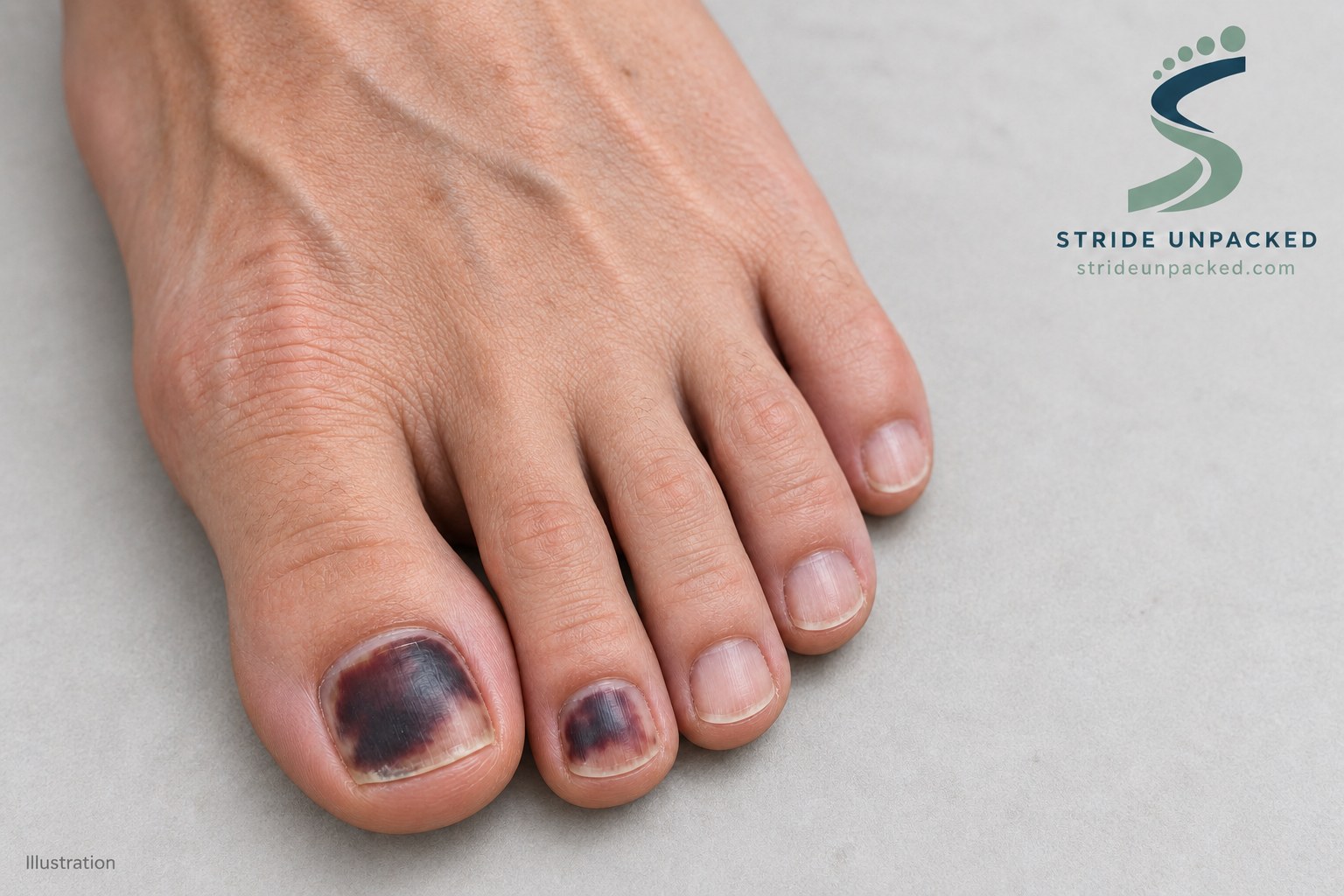
Why do toenails turn black after running or walking?
You finish a long run or a hill walk, take your shoes off and notice a purple or black toenail. It may be tender, or you may not have felt anything unusual while you were out.
In clinic, I often hear a familiar story: a walk over rough ground, plenty of climbing and descending, and a foot that has been moving inside the shoe. Repeated contact between the toes and the footwear can put pressure on the nails.
That repeated trauma can cause bleeding beneath the nail, known as a subungual haematoma. The trapped blood can look purple, brown or black. You do not necessarily need to remember one particular knock. [1]
As a podiatrist with 21 years of experience, and a runner myself, I look beyond the colour. I want to understand what happened, whether the toe hurts and why the same pressure might keep occurring.
Not every dark toenail is bruised. Unexplained discolouration needs assessment rather than an assumption that it must be caused by running.
Does a black toenail mean my shoes do not fit?
Sometimes—but the answer is not simply to buy a bigger pair.
I check the toe box, which is the space around the front of the foot. It may be too narrow, too shallow or too short. A seam can also create a pressure point over a particular nail.
A shoe may have enough space but still allow too much movement. If it is not secured appropriately, the foot can slide forwards and the toes can repeatedly contact the front, particularly on descents.
The aim is room for the toes alongside a secure, comfortable hold around the rest of the foot. More space is not automatically better if it means more sliding.
How can I reduce my risk of black toenails?
Keep nails neatly trimmed
Before a long run or walk, check your toenails. Keep them reasonably short, cut straight across and file rough edges. Avoid cutting them very short or digging down the corners. [2]
Check the fit with the socks you will wear
Make sure there is space in front of the toes and above the nails, without pressure from the upper or seams. Try the footwear with the socks you actually intend to use.
Depending on the brand and fit, I may suggest trying half a size or a full size larger than someone's usual footwear. That is a starting point for comparison, not a rule for everyone. Choose according to how the shoe fits and holds your foot, rather than the number printed on it.
Choose socks that work with your footwear
Injinji and Feetures are examples I suggest to patients, including suitable trail options for hill walking. These are my practical preferences, not a claim that either brand has been proven to prevent black toenails better than every alternative.
Check the overall combination: the socks should feel comfortable without bunching or making the toe box crowded. You do not need a particular brand to address a footwear-fit problem.
Ad · Amazon affiliate links: Stride Unpacked may earn a commission if you buy through the links below, at no extra cost to you. As an Amazon Associate I earn from qualifying purchases.
View Injinji Trail Midweight Mini-Crew socks on Amazon (affiliate link)
View Feetures Elite Light Cushion Mini Crew socks on Amazon (affiliate link)
Check the size and colour selected on Amazon before ordering.
For my experience of wearing both brands, read Injinji vs Feetures: A Podiatrist’s Running Sock Review. The review includes my clinic stockist relationship and Amazon affiliate links.
Pay attention to lacing
I often recommend trying a heel-lock or runner's-loop lacing method, sometimes called marathon lacing, to help hold the heel more securely and reduce forward movement.
It should feel secure, not constricting. Do not keep tightening laces to compensate for footwear that does not fit. A podiatrist or footwear professional can help you check the setup.
Try changes before a long outing
Check a new shoe, sock or lacing combination on a shorter outing first. If you notice your toes repeatedly hitting the front or pressure building over a nail, address it rather than waiting until the end of a long day.
Appropriate footwear, nail care and reducing repeated pressure are also central to Cleveland Clinic's advice on runner's toe. [3]
Can I keep running or walking with a black toenail?
If there is a clear history of pressure or trauma, the nail is painless and the surrounding skin is healthy, I would not automatically tell someone to stop all running or walking. I would advise them to monitor it and address the likely cause.
That is different from pushing through pain. Reduce or pause the activity if it is aggravating the toe, and seek advice if symptoms are worsening.
Weeping, increasing redness, warmth, swelling or worsening pain need assessment because they can indicate infection or another problem. Do not rely on a couple of days off or a salt-water soak to deal with a possible infection. Seek prompt advice from a podiatrist or GP; use NHS 111 if you need urgent guidance. [2]
A recently injured nail with severe throbbing pain may need professional treatment to relieve pressure. Do not pierce or drain it yourself. [1, 3]
Will the nail fall off, and what if it loosens?
In my clinical experience, a traumatised nail often loosens and may eventually come away. It may happen later rather than immediately. However, a black toenail does not always fall off.
I recommend removing nail varnish so that you can see the nail and monitor changes clearly.
If a small edge is completely detached and catches on socks, it may be carefully trimmed if you can do so comfortably. Do not pull the nail off, cut into attached nail or cut anything that causes pain or bleeding. Protect an exposed area with a clean dressing and seek help if you are unsure. [2, 3]
A podiatrist can help manage a loose nail that is difficult to deal with yourself. There is no need to struggle with it or force it off.
How long does a toenail take to grow back?
It depends partly on which nail is affected. In my clinical experience, smaller toenails may regrow in around 3–6 months, while a big toenail can take around 12 months.
Those are approximate clinical estimates, not deadlines. Some nails take longer: NHS guidance says toenails lost after injury can take up to 18 months to grow back. [2]
A new nail may not immediately look like the old one. Damage to the nail's growth area can affect its shape or appearance, particularly after repeated injury. [3]
Addressing the source of pressure matters while the replacement nail grows. Repeatedly traumatising the same toe can keep the problem going.
When should I get a black toenail checked?
A painless nail after a clear episode of pressure may be monitored. But arrange an assessment if the discolouration has no obvious explanation, is changing or is not moving towards the tip as the nail grows. A new or widening dark stripe, or pigment spreading onto nearby skin, also needs medical assessment. Nail melanoma is uncommon, but it is one reason unexplained pigmentation should not be dismissed as a running injury. [1]
Seek advice for painful, red, swollen or warm skin around a nail, discharge, or a nail that changes colour or falls off without a known reason. If you have diabetes, seek advice about a nail problem rather than attempting to manage a damaged nail yourself. [2]
If black toenails happen regularly, I recommend investigating why. A trainer or walking-boot assessment can identify pressure points or excessive movement. Depending on the findings, video gait analysis may help explore how you move in the footwear. It is an option within an assessment, not something every black toenail requires.
The aim is to keep you comfortably active while reducing repeated trauma—and to check that bruising really is the explanation.
Sources & further reading
This is general education, not a personal diagnosis or an individual treatment plan. Read our health information disclaimer.