
Skin & Nails / READ
Painful Corn on Your Toe? Why It Keeps Coming Back and What Helps
Podiatrist Anne Stewart explains why corns form on toe tips, why they return, and how footwear, pressure relief and professional care can help—with before-and-after clinical photographs.
Let’s play detective.
Treating corns is something I’m passionate about—and one of the things I love doing in clinic. There’s nothing more satisfying than helping a patient walk pain-free again and get back to the activities they enjoy.
But I’m just as interested in finding out why the corn developed in the first place.
That’s where we become a detective team. You know your feet, your footwear and when things hurt. I bring 21 years of podiatry experience. Together, we piece together the clues: a curled toe, a tight shoe, an awkward seam or pressure you hadn’t noticed.
Removing the corn is part of the appointment. Working together to tackle what’s causing it is how we give you the best chance of lasting relief.
Why do corns develop on the ends of toes?
A corn is a localised area of thickened skin that develops in response to repeated mechanical stress. Pressure and rubbing can both contribute. A hammer toe or claw toe can change how the tip—the apex—contacts the ground or footwear. [1]
In clinic, I also look for shoes that are too short or tight, internal seams and sock or hosiery seams that sit against the sore area. Sometimes several factors are involved. It is not always the shoe, and it is not always the toe shape alone.
People often describe a small, raised area of hard skin that hurts when touched or pressed. That description is useful, but an examination helps establish whether it really is a corn rather than another skin problem.
What is the difference between a corn and a callus?
A callus is usually a broader patch of thickened skin. A corn is more concentrated and often has a central hard core. Both can result from pressure and friction; it is too simple to say that one is only pressure and the other only friction. [1, 2]
A small corn can be very uncomfortable because pressure is concentrated through that firm area onto the tissues beneath. I see it as a reason to investigate the pressure, rather than simply remove the visible hard skin and forget about it.
That does not mean every corn will become an ulcer. Skin breakdown is a particular concern in vulnerable feet, including where circulation or sensation is impaired. A person with reduced sensation may not feel pain even when there is a problem. [3]
Do corns have roots—and why do they keep coming back?
Patients sometimes ask me, “Did you get the root out?” A corn does not have a root like a plant. What people think of as the root is the compact central core of hard skin.
A podiatrist can remove that core, a procedure called enucleation, along with surrounding callus where appropriate. But removing the corn does not necessarily remove the pressure that caused it.
That is why I think of treatment as a jigsaw puzzle. Is the toe curling down? Is there a seam against it? Does the shoe leave enough space? Has someone spent longer walking in footwear they rarely wear?
Addressing those factors can reduce recurrence. Some people still need ongoing care, particularly when toe position or other contributing factors cannot readily be changed. I would not promise that one treatment will prevent every future corn.
What changes can help reduce the pressure?
I usually start with the shoes and socks someone actually wears. A rounded, roomy toe box is often useful, but its shape alone is not enough: the shoe needs sufficient length, width and depth for that person’s toes. A curled toe may need extra space above it as well as in front of it.
I also suggest looking for socks with little or no prominent toe seam. Check that the sock itself is not tight or bunched up. Bring your usual shoes to the appointment; they can provide useful clues.
Can leather or silicone toe props help?
Where toe position is contributing, I may recommend a leather toe prop or a silicone prop. These sit beneath the toes and can help support them and redistribute pressure away from their tips. Both are options I use according to the individual, rather than treating one material as the answer for everyone.
The fit matters. A prop must leave enough room in the shoe and should not create a new pressure point. It may help accommodate a curled toe; it does not necessarily straighten a rigid toe permanently.
Research is limited. In a small study involving 22 people, gel and silicone props reduced pressure at the second-toe tip, while the leather prop did not show a significant reduction at that site. That finding supports checking the effect of the chosen device rather than assuming all props work equally well. [4]
People with reduced sensation or poor circulation should have professional advice before trying a device and should not rely on comfort alone to judge its fit. I will cover individual products and their limitations in a separate review; this article does not require you to buy a particular product.
Should I use a medicated corn plaster or cut it out myself?
My advice is not to cut a corn out yourself. A blade or razor can injure the skin; professional removal involves assessment and training, not simply copying what you have seen in a treatment video. [1]
I am also cautious about people using medicated corn plasters without professional advice. In my clinic, I have treated patients with skin damage after using them, particularly where the medicated area contacted healthy skin or was left in place without adequate monitoring.
Medicated plasters commonly contain salicylic acid, which breaks down thickened skin but can also damage surrounding skin. These are different from unmedicated cushioning pads.
There is an important distinction between that clinical concern and saying these products never work. A randomised trial found salicylic-acid plasters effective when applied under podiatrist supervision to carefully selected patients. It excluded people with diabetes, poor circulation, neuropathy and previous foot ulcers, among other exclusions. Those findings should not be treated as reassurance for unsupervised use in higher-risk feet. [5]
What happens at a podiatry appointment?
If you come to see me, I begin with your medical history and the story of the problem. How long has it been there? When did you first notice it? Had you been on an unusually long walk or worn different shoes for a wedding?
I assess the area and the factors that may be contributing. Where appropriate, I carefully remove surrounding hard skin and enucleate the corn—remove its central core. We then discuss how to reduce the pressure and whether footwear changes, a suitable prop or follow-up care may help.
Before and immediately after treatment
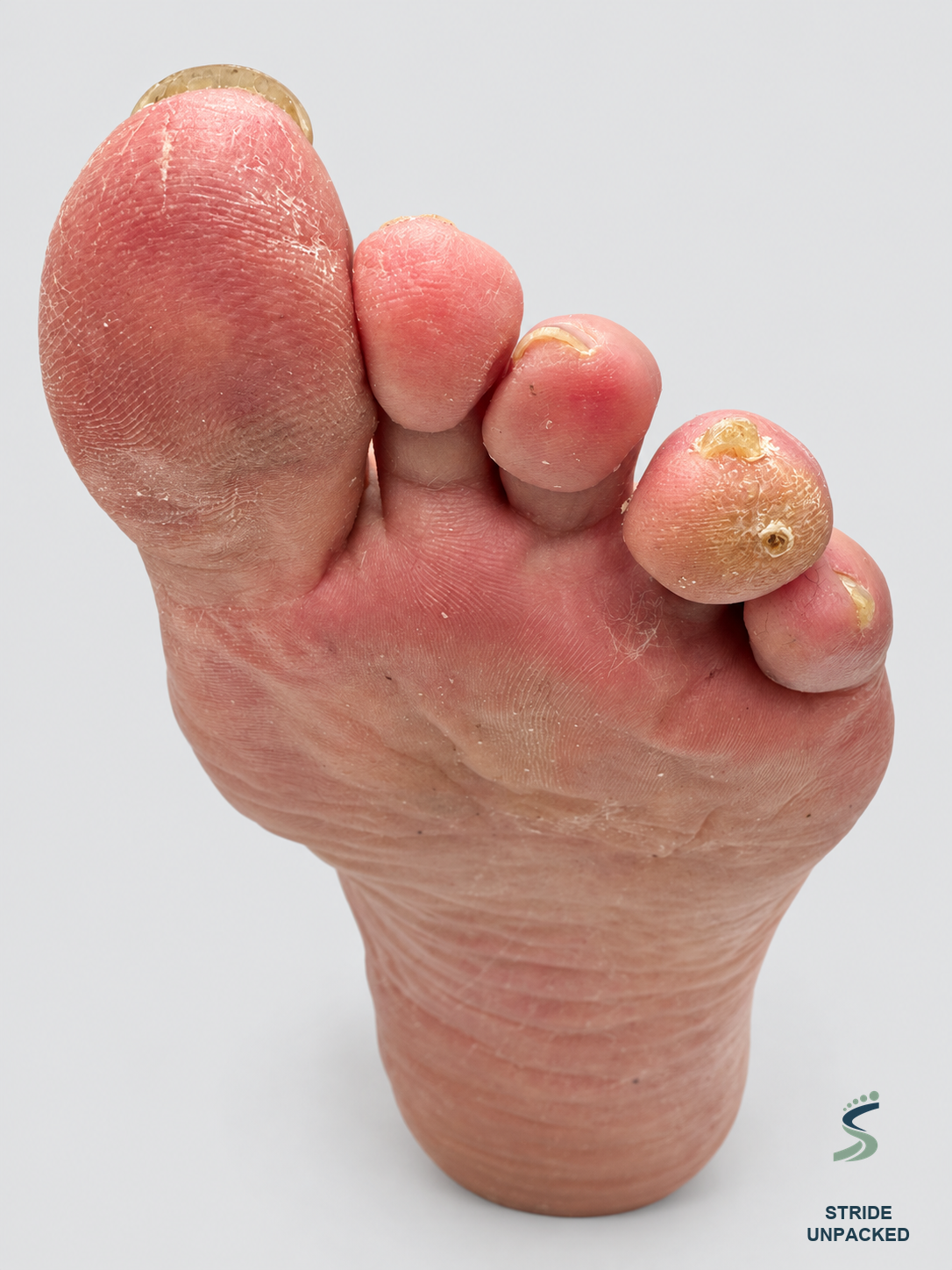
These clinical photographs show the same toe before treatment and immediately after enucleation. They are shared with the patient’s consent. Stride Unpacked branding has been added outside the foot; the clinical details have not been altered.
**Before treatment:** the corn and surrounding hard skin at the toe tip.
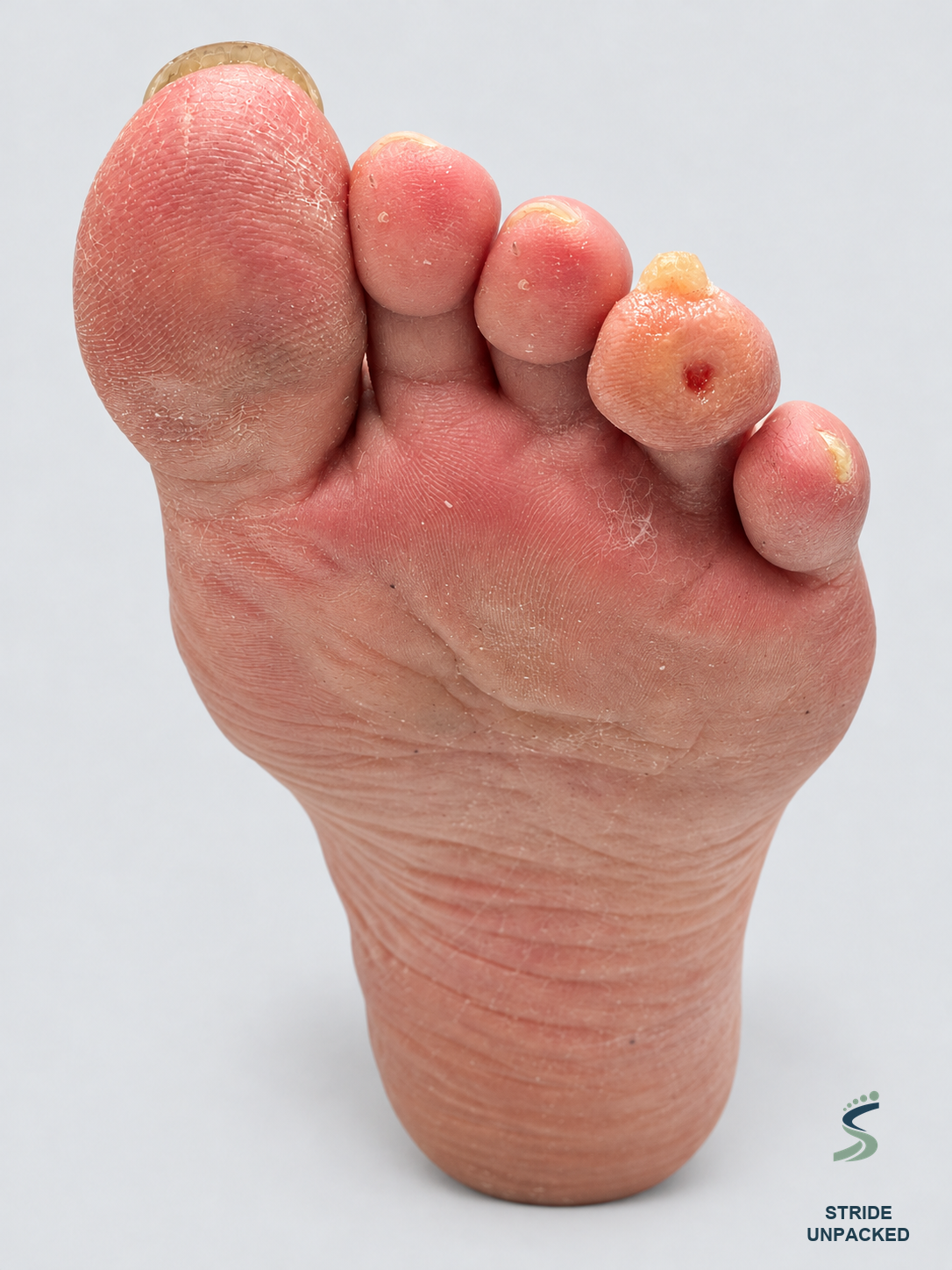
**Immediately after treatment:** the central corn has been removed. Anne confirms that the red area is underlying tissue irritation associated with pressure from the corn and callus, not an open wound. This is an immediate post-treatment appearance, not a photograph of long-term healing or proof that the corn will not recur.
When should I seek advice?
I recommend an HCPC-registered podiatrist for a painful or recurrent corn, especially when it affects walking or the activities you enjoy. You do not need to wait until it becomes severe.
Seek professional advice rather than treating it yourself if you have diabetes, poor circulation or reduced feeling in your feet. Check your feet daily if sensation is reduced; use a mirror or ask someone to help if you cannot see them properly. [1, 3]
Bleeding, discharge, broken skin, increasing redness, warmth or swelling need medical assessment. Seek prompt advice for a new wound in a foot affected by diabetes or poor circulation, and urgent help if redness is spreading or you feel unwell. Do not cover an unexplained lesion with acid treatment and assume it is simply a corn. [1, 3]
Keep building your understanding
The aim is to make walking more comfortable while addressing the reason the corn formed. Removing hard skin and managing pressure are connected parts of that plan.
Explore our other foot and lower-limb guides, or read our editorial approach to see how clinical experience and research inform our content.
This article provides general education and cannot diagnose a skin lesion or replace an individual assessment. Read our health information disclaimer.
Sources & further reading
2. Wirral Community NHS: Foot care
3. Northern Diabetes Foot Care Network: Foot care for patients at moderate risk
4. The effect of three different toe props on plantar pressure and patient comfort
5. Salicylic acid plasters compared with scalpel debridement: randomised controlled trial
This is general education, not a personal diagnosis or an individual treatment plan. Read our health information disclaimer.