
Ankle / READ
Why Does My Achilles Hurt? Common Causes and What to Do Next
Pain at the back of your heel or further up the Achilles? Dan Broadhead explains assessment, progressive loading, stretching, heel lifts and the symptoms that need urgent attention.
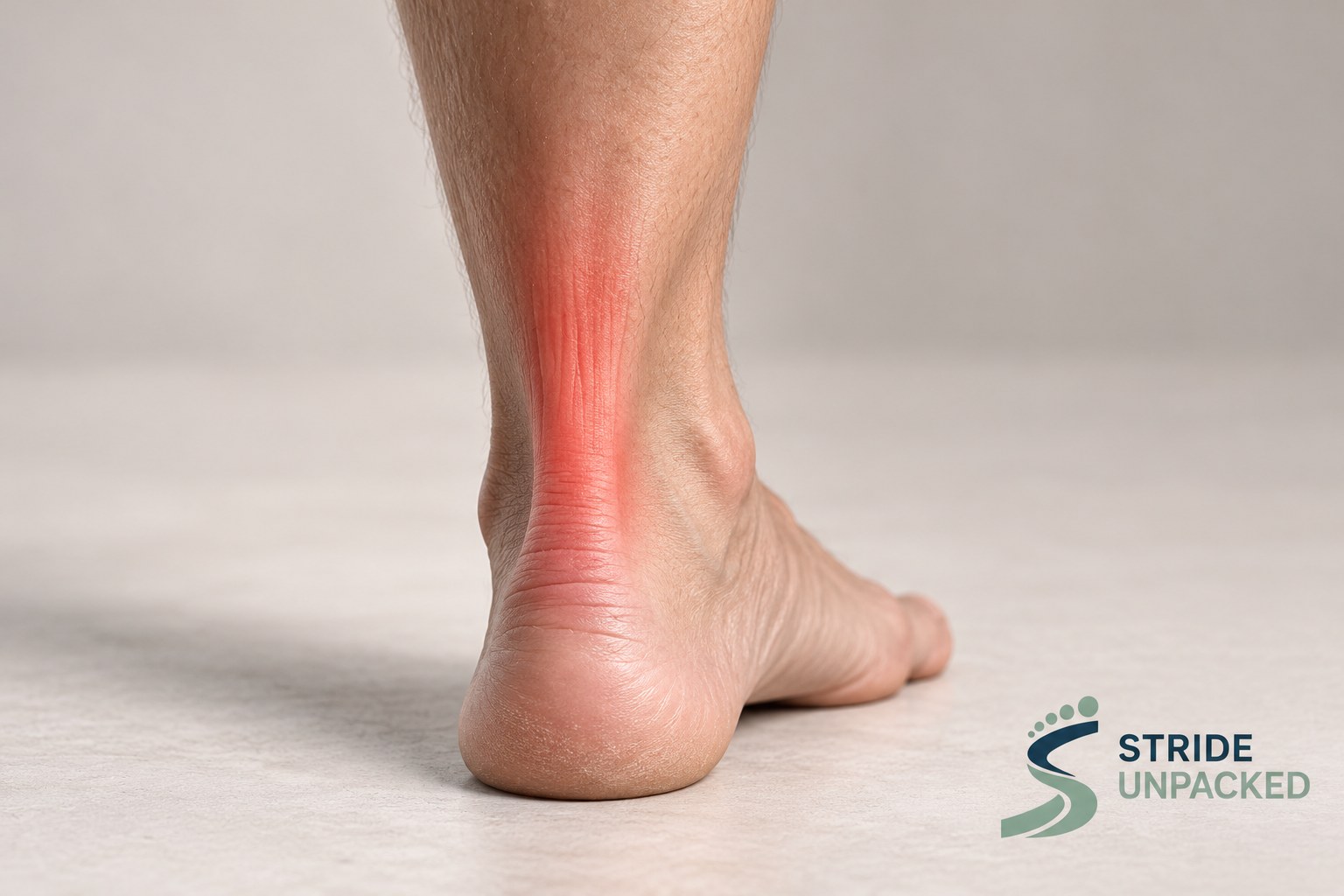
When does Achilles pain need urgent assessment?
A sudden pop, snap or feeling that someone has kicked the back of your leg needs urgent assessment, particularly if pushing off becomes difficult or you develop swelling or bruising. These can be signs of an Achilles tear or rupture. Being able to walk does not rule one out. Stop exercising and seek same-day urgent medical advice; do not try repeated heel raises or stretches to test it yourself. [1]
The rehabilitation discussion below is for assessed Achilles tendinopathy, not a suspected tear or rupture.
Where is the pain coming from?
People often come into clinic saying they have “heel pain”. But pain underneath the heel and pain at the back of it can have different causes. Advice for plantar fasciitis may not be appropriate for a painful Achilles.
The Achilles connects the calf muscles to the heel bone and helps you push off when walking, running and rising onto your toes. [1]
I first establish exactly where someone feels their symptoms. Pain around the attachment at the back of the heel may involve insertional Achilles tendinopathy. Pain further up the free part of the tendon may be mid-portion tendinopathy. Location helps guide the assessment; it does not establish the diagnosis on its own.
Other structures can hurt in this area too. These include the retrocalcaneal bursa, between the tendon and heel bone, and a superficial bursa beneath the skin at the back of the heel. A bony prominence, sometimes called Haglund’s deformity, can also be relevant. My job is to work out which structures are contributing, rather than assume every sore heel is the same problem.
If your pain is underneath the heel, our guide to first-step heel pain explains a different common presentation.
Is it Achilles tendinitis or tendinopathy?
“Tendinitis” suggests inflammation. “Tendinopathy” is the preferred clinical term for persistent tendon pain and loss of function associated with loading; it does not assume a particular microscopic process. These are not simply two stages that everyone passes through. [2]
Pain during activity, pain afterwards and morning stiffness are useful details, but they cannot establish whether inflammation is present. I consider the history, examination and any relevant scan findings together.
What do I assess in clinic?
I want to know when symptoms started, whether there was a specific incident, and what has changed in someone’s activity. More running, hills, longer walks or more time on their feet can all be relevant to that conversation.
I examine the tender area and assess ankle movement with the knee straight and bent. Changing the knee position helps me explore how the calf muscles contribute to the movement and symptoms. I am interested in where discomfort occurs, rather than simply how far the foot moves.
Once an acute injury has been ruled out, I may ask someone to perform a heel raise on both legs, then on one leg if appropriate. Can they lift their heel? Is the movement controlled? Does pain or fatigue limit them? This helps me choose a manageable starting exercise.
I also use diagnostic ultrasound in my clinic when appropriate. It can add information, but a scan is not required for every typical presentation and cannot reliably predict recovery time. [3] Increased blood flow on Doppler ultrasound should not automatically be labelled acute inflammation. [4]
What helps in the first few weeks?
My starting point is to reduce the activities that repeatedly aggravate symptoms and find a level of exercise the person can manage. That might mean temporarily reducing running, hill walking or the length of time spent on their feet.
The aim is to build the tendon’s ability to cope with everyday demands. In my practice, that means a progressive loading programme, adjusted to the person’s pain, strength and activity goals.
If pain makes rehabilitation difficult, I may discuss additional symptom management and liaise with the patient’s GP. Medicines need an individual suitability check; this is not a recommendation to start a standard course of anti-inflammatory tablets. Guidelines advise caution with NSAIDs in Achilles tendinopathy. [3]
Should I do heel raises or stretch my Achilles?
As a general starting point, I use heel raises from floor level rather than asking someone to lower their heel below a step. In my experience, forcing a stretch into a painful tendon can keep provoking symptoms.
I sometimes use exercises adapted from an eccentric programme such as the Alfredson protocol, but the starting point depends on what the patient can do. A modified exercise is not necessarily the original research protocol.
Options I use include two-legged heel raises, progression towards one leg, and seated calf exercises. If these are too demanding, a resistance-band exercise may provide a more manageable starting point. The number of repetitions, resistance and frequency need to be chosen for the individual.
For insertional pain, limiting compression at the heel attachment is particularly relevant. A trial in sport-active adults found better outcomes with a programme combining controlled ankle movement, heel lifts and progressive exercise, compared with a programme allowing more compression. This tested a package of care, not a heel lift or exercise in isolation. [5]
Lowering below a step is therefore an optional progression, not a milestone everyone must reach. Stretching and a greater range of movement may be appropriate later, but should not be forced because an online programme says so.
How much discomfort is acceptable?
My usual starting guidance in clinic is mild discomfort, no more than about 3 out of 10, and an effort level around 7 out of 10 or less so that the person can maintain control. These are my practical starting limits, not universal rules or a guarantee that an exercise is suitable.
I ask patients to compare symptoms the following morning with their usual baseline. If pain or stiffness is noticeably greater, lasts longer or is building over successive days, the total load needs reviewing. Consider the walk, work shift or run as well as the rehabilitation exercises.
An exercise can often be made easier. Putting the other foot down during a single-leg heel raise shares the load, although it does not necessarily halve it exactly. A seated exercise or resistance band may be another option after assessment.
If symptoms are progressively worsening, your ability to exercise is declining, or the pain changes in character or location, seek advice rather than repeatedly pushing through.
Can footwear or heel lifts help?
I sometimes recommend a heel lift to make standing and walking more comfortable while rehabilitation continues. Some patients also find a shoe with a higher heel relative to its forefoot more comfortable than very flat footwear or going barefoot.
For Achilles symptom management, use equal-height lifts in both shoes unless your clinician has advised a different arrangement. This avoids introducing an uneven heel height, even when only one tendon is painful. NHS Borders gives the same advice about using lifts in both shoes. [6]
A lift still needs to fit the shoe: your heel should remain secure rather than slipping out or rubbing. Height and suitability should be guided by comfort, shoe fit and assessment, rather than assuming more lift is better.
A heel lift I recommend in clinic
I have used and prescribed Bukihome adjustable orthopaedic heel lifts. The feature I value is their adjustability, which allows the setup to be adapted rather than committing to one fixed height.
Where a patient needs additional support or a change in how the foot is loaded, I may instead use an insole with a heel lift attached. The choice depends on the person and their footwear.
I purchase the Bukihome lifts myself for clinical use. I have not personally worn them because I have not had a clinical need, and I have no relationship with the brand. This is a clinical recommendation, not a personal wear test or evidence that this brand is superior to other suitable lifts.
**Affiliate disclosure:** The following is an Amazon affiliate link. Stride Unpacked may earn a commission if you buy through it, at no extra cost to you. As an Amazon Associate I earn from qualifying purchases.
View Bukihome adjustable heel lifts on Amazon (affiliate link)
You do not need to buy this particular product to follow an appropriate rehabilitation plan.
How long does Achilles tendinopathy take to improve?
In clinic, I look for measurable progress at around three to four weeks: perhaps more controlled heel raises, better walking tolerance or less pain. This is a review point, not a deadline that every patient must meet.
Some patients notice meaningful changes over six to eight weeks, but I would not promise full recovery in that time. Guidelines recommend at least 12 weeks of progressive strengthening, and recovery can take months. [3]
Progress is not always a straight line. Someone may feel stronger and do more, then notice their symptoms again. I consider what they can do, how symptoms respond afterwards and whether their overall trend is improving. Doing more is useful progress only if the response remains manageable.
If there is no progress at an early review, I check the diagnosis, exercise technique, programme and everyday activity demands. Additional treatments are individual decisions, not an automatic next step at week four. Guidelines suggest discussing options such as shockwave after about three months of an adequate programme without improvement, acknowledging uncertain additional benefit. [3]
What mistakes should I avoid?
The first is repeatedly stretching a painful Achilles because it feels tight. I often see people doing this in the hope of loosening it, when the movement is simply aggravating their symptoms.
The second is buying into “this will fix your Achilles” promises. A product may be useful, but it needs a purpose within the plan. Buying another device is not a substitute for checking why progress has stalled.
The third is expecting every week to feel better than the last. I encourage patients to monitor both symptoms and function, while making sensible adjustments. The aim is a plan that works around real life and gradually prepares you for the things you want to do.
When should I get advice?
Arrange an assessment if the diagnosis is uncertain, symptoms affect daily life, or your current approach is not helping. Seek reassessment sooner if symptoms change or function deteriorates.
A sudden pop, feeling of being kicked, or new difficulty pushing off warrants urgent same-day assessment for a possible tear or rupture. Do not use this article’s exercise discussion to manage a suspected acute injury. [1]
Keep building your understanding
Meet Dan and read about his clinical background.
Explore the library for more lower-limb health explanations, or read how I approach education and product recommendations.
This article provides general education for adults. It cannot establish your diagnosis or prescribe a personal rehabilitation programme. Read our health information disclaimer.
Sources & further reading
1. Cambridge University Hospitals: Achilles tendon rupture
2. ICON 2019 consensus: clinical terminology
3. Dutch multidisciplinary guideline on Achilles tendinopathy
4. Recommended musculoskeletal and sports ultrasound terminology
5. Reducing tendon compression in insertional Achilles rehabilitation: randomised trial
This is general education, not a personal diagnosis or an individual treatment plan. Read our health information disclaimer.