
Heel & foot / READ
Heel Pain in the Morning: Is It Plantar Fasciitis?
Why your first steps can hurt, what plantar fasciopathy means, other causes of heel pain, and when to seek help. A practical guide from Dan Broadhead.
BSc(Hons), PG Cert (MSK US)
Sports Podiatrist · Applied Sports Scientist · Lower Limb Musculoskeletal Sonographer
Former GB Junior Athlete
Do your first steps out of bed hurt your heel? Does the pain ease once you get moving, only to return when you stand up after sitting down?
This pattern is common with plantar fasciitis, also called plantar fasciopathy. However, several conditions can cause heel pain. Understanding the pattern is a useful starting point—not a diagnosis on its own.
Why does my heel hurt when I first get out of bed?
After a night’s rest, the area can feel stiff. Those first steps put weight through tissue that is already sensitive, which can trigger pain around the heel.
You might find the discomfort eases as you move around, then returns after you sit down for a coffee and get up again. This is often called “first-step pain.”
The same thing can happen when you get up during the night to use the toilet. That is different from pain that wakes you while you are lying still.
First-step pain is a recognised feature of plantar fasciopathy, although it does not mean every painful heel has the same cause. [1]
What is the plantar fascia?
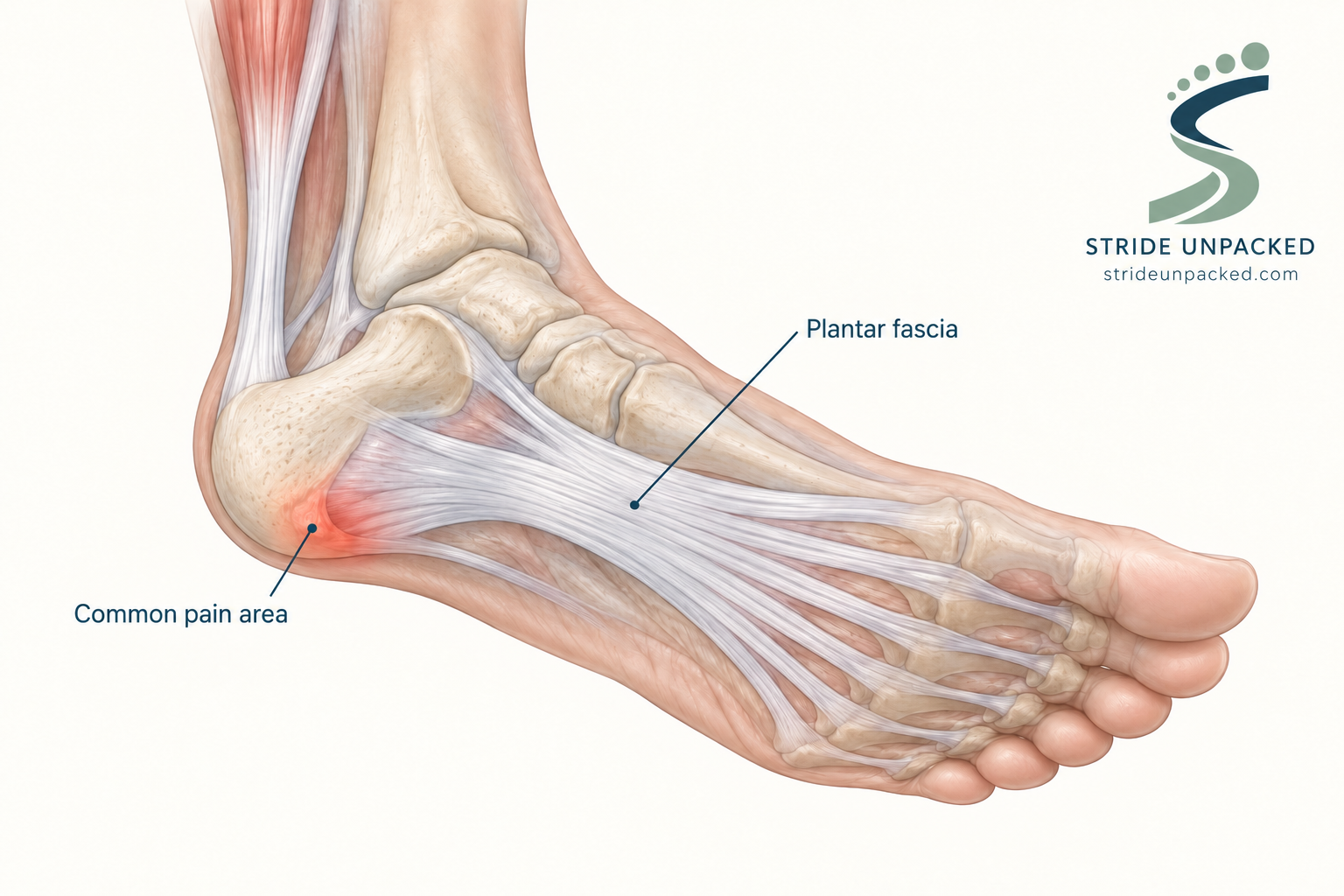
The plantar fascia is a thick, strong band of tissue running from your heel bone—the calcaneus—along the underside of your foot towards your toes.
It helps support your arch and contributes to how your foot handles load during walking and running.
You have probably heard the term plantar fasciitis. The ending “-itis” suggests inflammation. However, persistent plantar fascia pain often involves changes in the tissue’s structure, rather than being explained by inflammation alone.
That is why I often use plantar fasciopathy: a broader term for a problem affecting the fascia, without assuming inflammation is the main cause. It does not mean inflammation can never be present. [2]
In clinic, ultrasound can help assess the fascia’s thickness and structure when needed. Those findings are considered alongside your symptoms and examination. A scan alone does not explain every person’s pain, and not everyone needs one.
What symptoms suggest plantar fasciopathy?
In clinic, I look for the overall pattern:
- Pain underneath the heel, often towards its inner side.
- Pain on the first steps after sleep or rest.
- Discomfort that may ease initially with movement.
- Pain that may increase again with prolonged standing, walking or running.
- Tenderness where the plantar fascia attaches to the heel bone. [3]
Severity varies. Some people continue their usual activities with mild discomfort; others find the pain significantly limits what they can do.
I may also assess movements such as a single-leg calf raise to see how comfortably the foot and calf handle load. Difficulty with this movement helps guide the assessment, but does not confirm the diagnosis by itself.
Pain often settles when you take weight off the foot. Persistent pain at rest deserves a closer assessment rather than automatically being attributed to plantar fasciopathy.
Could something else be causing my heel pain?
Yes. Other possibilities include:
Nerve irritation
Tarsal tunnel syndrome and Baxter’s nerve entrapment involve different nerves around the ankle and heel. Symptoms can overlap with plantar fascia pain. Burning, tingling or numbness may suggest nerve involvement, although these are not always present. Nerve irritation and plantar fasciopathy can also coexist.
A stress fracture
Repeated loading can cause a stress fracture in the heel bone, sometimes after an increase in walking, running or impact activity. There may be no single obvious injury.
Heel fat-pad problems
The specialised cushioning pad beneath the heel can become painful or damaged. This may produce a deep, bruised feeling near the centre of the heel, particularly on hard surfaces.
Tendon problems
Nearby tendons can contribute to pain around the heel and inner ankle. One example is the flexor hallucis longus tendon, which helps bend the big toe downwards.
These are examples, not a complete list. Where the pain occurs, how it started and the examination findings help distinguish between possible causes. [4]
What can I do to help?
My initial approach is to make everyday activity more comfortable while gradually building the foot’s capacity to cope with load.
Choose comfortable, supportive footwear
A comfortable shoe with suitable cushioning and support may help settle symptoms. Some people find arch support helpful, but there is no single shoe that suits everyone.
Adjust activities that repeatedly aggravate the pain
We look at how much standing, walking and running you are doing. Temporarily reducing activities that repeatedly flare symptoms can help. This usually means adjusting the amount you do, rather than stopping all activity.
Use stretching where appropriate
Calf and plantar fascia stretches may help with symptoms and movement restrictions. They should fit your needs and form part of an individual plan. [3, 5]
Build strength gradually
Progressive strengthening is another part of my approach. One option is a slow heel-raise exercise adapted to load the plantar fascia, based on the high-load programme studied by Rathleff and colleagues.
That study supports strengthening as a useful option, but does not establish it as the best treatment for everyone. The starting difficulty and progression should match what you can tolerate. [6]
Consider taping for short-term relief
Strapping the foot can help reduce symptoms during daily activities. It can support rehabilitation by making it easier to stay active and carry out exercises.
Symptom relief and progressive loading can work together. Taping is one tool within the plan. [5]
When should I get my heel pain assessed?
All too often, I see people who have lived with heel pain for years before seeking help. You do not need to wait that long.
Arrange an assessment if your attempts to manage the pain are not helping, symptoms are worsening, or everyday activities are becoming difficult.
NHS guidance recommends seeking advice if heel pain has not improved after two weeks of self-care. This is a point at which getting advice is sensible—not a deadline by which plantar fasciopathy should have completely recovered. [1]
If treatment is not helping, we should review both the diagnosis and the plan. There may be another cause, more than one problem, or a need to adapt your rehabilitation.
Seek advice sooner if you have tingling or reduced sensation, or if you have diabetes and develop heel pain.
Get urgent advice through NHS 111 if you have severe heel pain after an injury, cannot walk, or your foot has changed shape. A snap or pop during an injury also needs urgent assessment. [1]
The aim is to understand what is causing your pain and develop a plan that fits your circumstances.
This article provides general information and cannot replace an individual assessment.
Sources & further reading
[2] Imaging of plantar fascia disorders
[3] Heel Pain—Plantar Fasciitis: Clinical Practice Guideline, 2023
[4] American Family Physician: Heel Pain—Diagnosis and Management
[5] Management of plantar heel pain: A best-practice guide
[6] Rathleff et al.: High-load strength training for plantar fasciitis
This is general education, not a personal diagnosis or an individual treatment plan.