Heel & Foot / READ
Not All Heel Pain Is Plantar Fasciitis: Where It Hurts
Heel pain is not always plantar fasciitis. Podiatrist Dan Broadhead explains how where it hurts points to the cause, and when to get checked.
People often arrive in clinic saying they have plantar fasciitis. Sometimes that is the right label. Quite often it is not. Pain under the inner heel, in the centre of the heel pad, at the back of the heel, or in a child can have different causes, and what helps one of those problems is not always the right first step for another.
This article contains affiliate links to product types I use in clinic. If you buy through those links, I may earn a commission. That does not change the price you pay, or the evidence discussed below. Those links are advertising, and each one is marked (Ad). You do not need to buy a product to follow this guide, and similar products from other brands are fine.
This is general information, not a diagnosis or personal medical advice.
Why does it matter where my heel hurts?
In clinic, the first thing I want to know is where the pain sits. Location is a useful clue, not a diagnosis on its own.
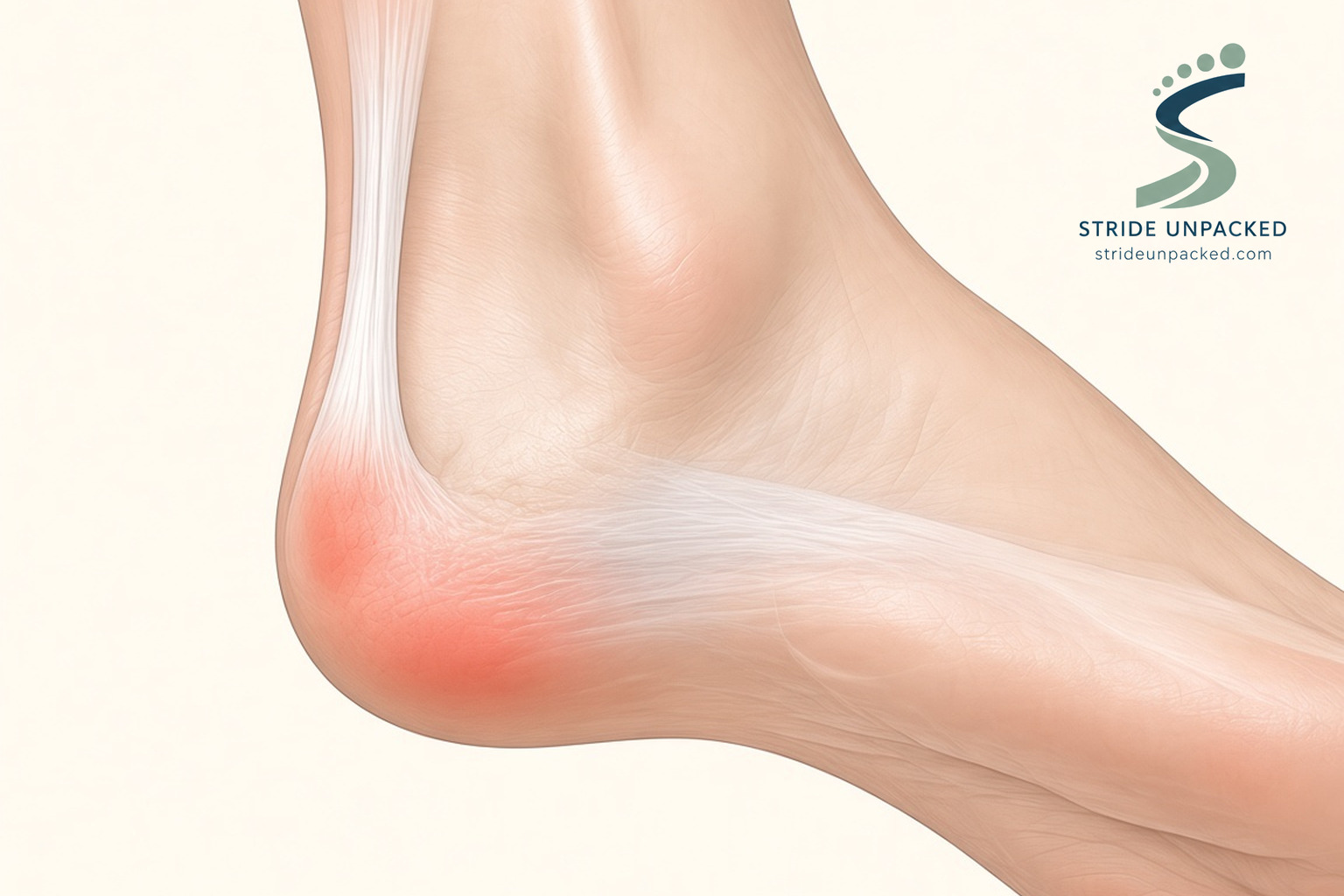
Plantar fasciopathy, often called plantar fasciitis, usually hurts under the inner heel, especially with the first steps after rest. Pain at the back of the heel may be the Achilles. A sore fat pad often feels like a bruise in the centre of the heel, particularly on hard floors. In children, activity-related pain at the back of the heel is often Sever’s disease, a growth-plate overload, rather than “plantar fasciitis in a child”.
Heel pain is common. About 1 in 10 UK adults aged 50 and over report plantar heel pain. [1]
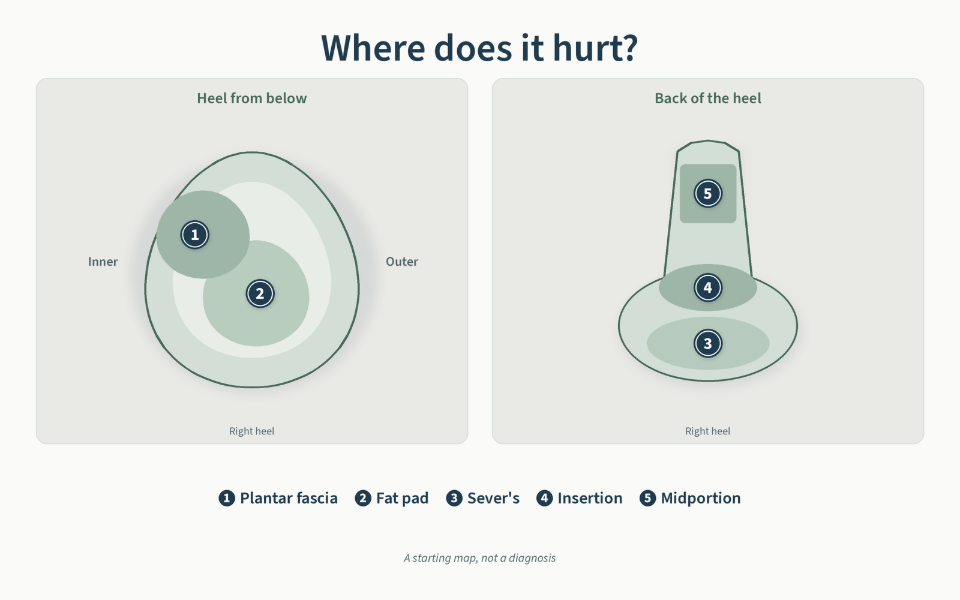
Where heel pain often sits. This is a starting map, not a diagnosis.
What does plantar fasciopathy usually feel like?
The usual pattern is pain under the heel, often towards its inner side, worse with the first steps after rest. It may ease once you get moving, then return after longer standing, walking or running. [2] Persistent pain at rest, rather than that first-step twinge, deserves a closer look.
Most people improve gradually over months, with most of the change in the first three months, using a simple package rather than complete rest. [3] There is good evidence for calf and plantar-fascia stretching, and for short-term taping used alongside other care. A night splint worn for one to three months is also well supported when first-step morning pain is a consistent problem. [2, 4] Cut back the things that repeatedly flare the pain, rather than stopping all walking. See our guides to walking and stretching.
As an Amazon Associate I earn from qualifying purchases.
A progressive heel-raise programme can help by three months. The main study was small, everyone already wore a shoe insert, and the extra benefit compared with stretching was not seen at one, six or 12 months. [5] In clinic, I usually begin with rehabilitation and activity advice. The trial used a rolled towel, not a device. I use the Fasciitis Fighter in clinic because it gives me a consistent shape; it is an optional tool, not a treatment programme. I bought the one I use myself. View the Fasciitis Fighter on Amazon (Ad). Our review and heel-raise guide explain when a towel may be enough.
Off-the-shelf contoured insoles can work as well as custom devices for this diagnosis, with a modest extra benefit over sham insoles at around 7 to 12 weeks. Use them as part of a wider plan, not as the only treatment. [6] I use off-the-shelf insoles in clinic. Superfeet is one example of a shop-bought arch-support insole; choose a size and arch height that fit your shoes. View Superfeet arch-support insoles on Amazon (Ad). See our insoles guide for how I review them.
I also use rigid tape and kinesiology tape in clinic for short-term support. Both are reasonable; comfort may favour the stretchy tape, and neither is a cure. [4] View Leukoplast rigid tape on Amazon (Ad). View Meglio kinesiology tape on Amazon (Ad). Have a safe method shown if you have not used tape before.
If those first morning steps are the main problem, I sometimes use a night splint in clinic for a one-to-three-month trial. [4] View a plantar fasciitis night splint on Amazon (Ad). It comes in three sizes, so check the size guide before ordering. Stop if it causes rubbing, numbness or a flare that does not settle. If you have diabetes, poor circulation or reduced feeling in your feet, get advice before using tape, a night splint, a heel cup or new insoles.
Footwear can support recovery; it does not replace understanding the cause of your heel pain. Choose a comfortable, reasonably cushioned shoe you will actually wear. In one trial, a shaped sandal helped as much as an insole and more than a flat flip-flop over 12 weeks, but a curved “rocker” shoe is not a proven cure on its own. [7] A heel lift is not a first-line treatment for this diagnosis, and I would not count rolling or ice as a proven programme.
What if the pain is in the centre of my heel?
A painful heel pad often feels like a deep bruise in the centre or towards the edges of the heel, typically worse barefoot or on hard floors. This is a different problem from the tight, first-step pain of plantar fasciopathy, and the two can be mixed up. Much of the usual plantar fasciopathy package has not been properly tested for fat-pad pain. [8]
Cushioned shoes, softer surfaces and less barefoot walking on hard floors are a reasonable first step, based on how the fat pad works rather than a treatment trial. [8] A soft heel cup can make standing more comfortable, but there is little direct trial evidence, so I would call this a comfort trial, not a proven fix. [8] I use heel cups in clinic. Tuli’s heel cups are one established example; choose the size and body-weight range that matches you. View Tuli’s heel cups on Amazon (Ad).
I would not automatically copy a full plantar fasciopathy plan. Get it checked if you are not sure, because these problems can be confused with one another.
Can children get plantar fasciitis?
They can, but in active children aged about 8 to 14, activity-related pain at the back of the heel is often Sever’s disease, a growth-related overload rather than “plantar fasciitis in a child”. It is common and usually settles, but a professional should confirm the diagnosis so that something more serious is not missed.
They usually do not need to stop sport completely. In one trial, wait-and-see, a heel raise and physiotherapy all improved pain by three months, with no difference between them. [9] A heel cup is a reasonable practical option, and in one study more than three-quarters of the children preferred it. [10] A heel raise or a prefabricated insole can also be used; the best recent review found little or no difference between them for short-term pain. [11] After the diagnosis has been confirmed, choose the option the child will actually wear.
Do not put an adult strengthening programme, a night splint or a bought device on a child’s undiagnosed heel pain without advice. If a heel cup is advised after assessment, the Tuli’s heel cups above come in sizes, including for lighter body weights. No brand has been shown to work better than another for children.
What if the pain is at the back of my heel?
People often come into clinic saying they have “heel pain”, and sometimes think the back of the heel can be plantar fasciitis.
Pain around the attachment at the back of the heel, usually within about 2 cm of the heel bone, may be insertional Achilles tendinopathy. Pain further up the free part of the tendon may be mid-portion tendinopathy. Location helps guide the assessment; it does not establish the diagnosis on its own. [12, 13] Other structures, including bursitis and a bony prominence sometimes called Haglund’s deformity, can also hurt here. If the back of your heel is sore, get it assessed rather than starting a plantar fasciitis stretching plan. Our guide Why Does My Achilles Hurt? covers assessment and loading.
For mid-portion pain, there is good evidence for education and a gradual loading programme. Complete rest is not usually the right first move. [13] A heel lift can be a short-term add-on, not the main treatment. In two trials, 12 mm lifts did slightly better than calf exercises in one and slightly better than sham lifts in the other, but in both the difference was below what the researchers had set as clinically important. [14, 15] In clinic, I sometimes recommend a heel lift for comfort while rehabilitation continues. Use equal-height lifts in both shoes unless advised otherwise, at a height that keeps the heel secure. I have used and prescribed Bukihome adjustable heel lifts in clinic. I purchased them myself, have not personally worn them, and have no relationship with the brand. View Bukihome adjustable heel lifts on Amazon (Ad). These are adjustable foam layers, not the firm 12 mm lifts used in the trials above, so the trial results do not apply to this product directly. You do not need this particular product, and an arch insole is not the main Achilles treatment. [16]
For insertional pain, loading still comes first, but the programme should limit compression at the attachment. [12, 17] In clinic, I am cautious about aggressive calf stretching into a sore insertion, and about shoes that dig into the back of the heel. A lift may be trialled for comfort with professional advice, as part of a loading plan, not as a stand-alone fix.
When should I get heel pain checked?
NHS guidance recommends seeking advice if heel pain has not improved after two weeks of self-care, is worsening, or is interfering with normal activities. [18] That is a sensible point to get advice, not a recovery deadline.
Arrange an assessment sooner if you are unsure what the pain is, you cannot walk without a limp, or any of the following warning signs apply:
- Pain that is worse at night, or pain at rest that is not the usual first-step morning twinge.
- Unexplained swelling, redness or heat, or a hot, swollen foot, especially if you have diabetes.
- Numbness, tingling, burning or weakness in the foot or leg.
- Fever, unexplained weight loss, morning stiffness in other joints, or pain in both heels at once.
- Recent trauma, or a sudden pop in the heel or arch, with bruising or a sudden loss of push-off.
- Heel pain in a child or adolescent — often Sever’s, but do not assume.
- A sudden inability to rise onto the toes, or heel pain after a sharp increase in running or jumping, especially with low energy intake or known bone-health problems.
Burning, tingling or numbness may suggest nerve involvement, such as tarsal tunnel syndrome or Baxter’s nerve irritation, although those symptoms are not always present. A stress fracture in the heel bone can also follow a sharp jump in training. Neither should be self-managed as plantar fasciitis.
Get urgent advice through NHS 111 if you have severe heel pain after an injury, heard a snap or pop at the time of the injury, cannot walk or stand on tiptoe, or your foot has changed shape. [19] Being able to walk does not rule out an Achilles tear, so a sudden snap or pop at the back of the heel still needs urgent assessment.
A clinician may sometimes discuss a steroid injection for persistent pain under the heel. That is a clinic decision, never a home treatment. Any relief tends to be short-term, and although serious harms appear uncommon, they may be under-reported, and plantar fascia ruptures and infections have been reported. [20] If treatment is not helping, we should review both the diagnosis and the plan. See our guide to how long plantar fasciitis takes to settle.
Keep Building Your Understanding
Heel Pain in the Morning: Is It Plantar Fasciitis?
Can I Keep Walking with Plantar Fasciitis?
Plantar Fasciitis Exercises: A Guide to Heel Raises
Stretches for Plantar Fasciitis: What Helps and How to Do Them
What Are the Best Shoes for Plantar Fasciitis?
Do Insoles Help Plantar Fasciitis—and Do You Need Custom Orthotics?
How Long Does Plantar Fasciitis Take to Get Better?
Why Does My Achilles Hurt? Common Causes and What to Do Next
Fasciitis Fighter Review: Why I Use It in Clinic—and Do You Need One?
How to Tape Your Foot for Plantar Fasciitis, Step by Step
WHERE TO BUY
Fasciitis Fighter
View on Amazon (Ad)Superfeet arch-support insoles
View on Amazon (Ad)Leukoplast rigid tape
View on Amazon (Ad)Meglio kinesiology tape
View on Amazon (Ad)Plantar fasciitis night splint
View on Amazon (Ad)Tuli’s heel cups
View on Amazon (Ad)Bukihome adjustable heel lifts
View on Amazon (Ad)Affiliate links: I may earn a commission if you buy, at no extra cost to you. As an Amazon Associate I earn from qualifying purchases.
Sources & further reading
This is general education, not a personal diagnosis or an individual treatment plan. Read our health information disclaimer.