Heel & foot / REVIEW
Fasciitis Fighter Review: Why I Use It in Clinic—and Do You Need One?
My experience of using the Fasciitis Fighter in clinic: repeatability, durability, limitations and when a rolled towel may be enough.
Why do I use the Fasciitis Fighter?
A rehabilitation exercise needs to be something you can repeat reliably. That is the main reason the Fasciitis Fighter has earned a place in my clinic.
I want the patient to understand the movement, find an appropriate starting point and be able to reproduce it. A familiar piece of equipment can make that setup simpler. Take it out, position it and begin the prescribed exercise.
That convenience matters to me. It does not mean the device is essential, or that buying it will resolve heel pain on its own.
What is it used for?
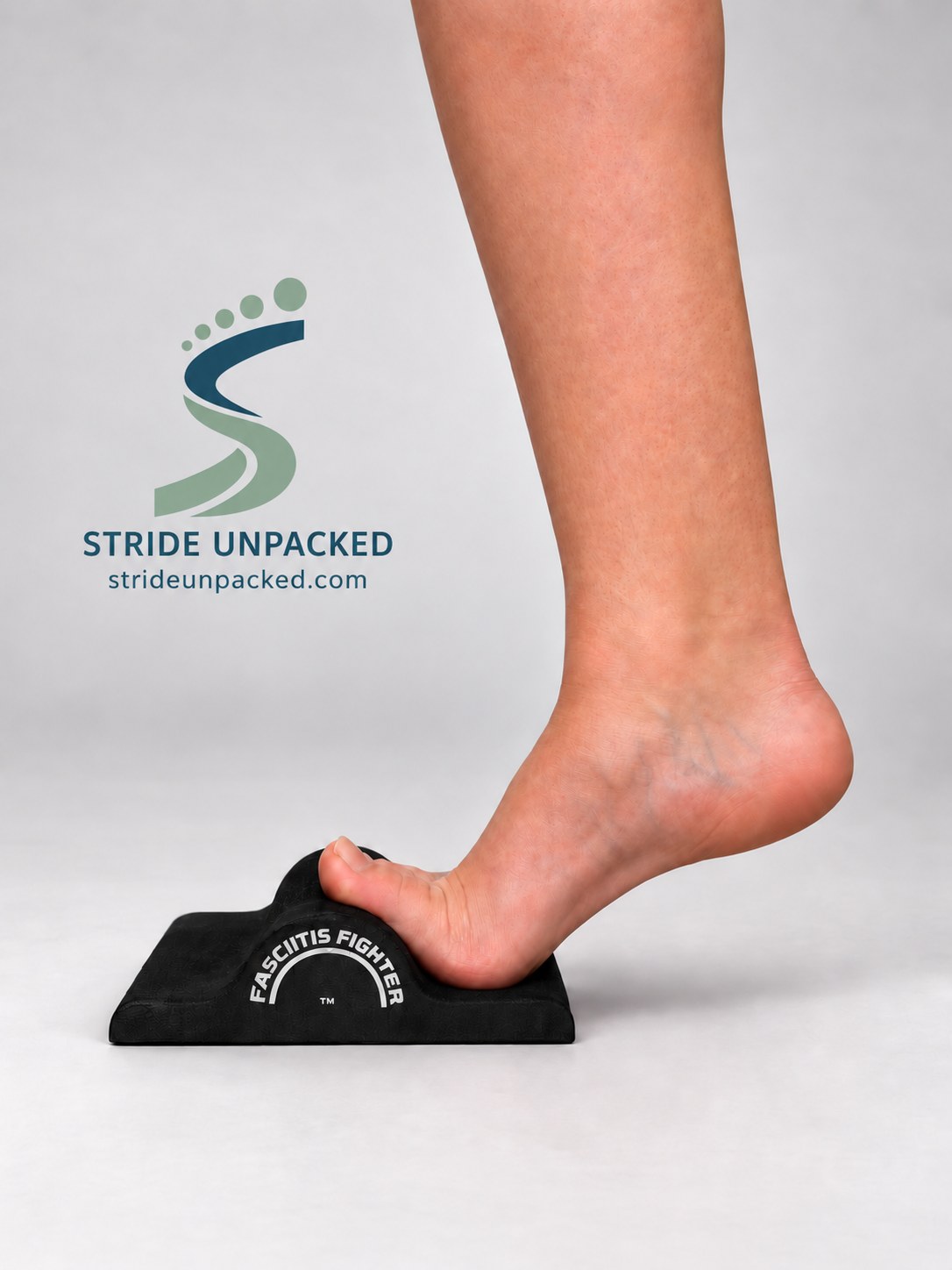
The Fasciitis Fighter provides a shaped support beneath the toes during heel-raise exercises. I use it as part of a rehabilitation plan for suitable patients with plantar fasciopathy, often called plantar fasciitis.
The exercise and its progression are the important parts of that plan. In clinic, I assess what a patient can tolerate before deciding whether to introduce toe elevation or increase the demand.
Our separate guide, “Plantar Fasciitis Exercises: A Guide to Heel Raises”, explains my starting variations, the Rathleff schedule and how I distinguish effort from pain. You can open it through Sources & further reading below.
Is it better than a rolled towel?
For consistency and convenience, I often prefer it. For flexibility and cost, a towel has clear advantages.
A towel’s size, thickness and the way it is rolled can change the setup. Some patients also find keeping a towel in the position they want awkward. The Fasciitis Fighter gives me a repeatable shape and firmness without recreating the roll each time.
But that consistency should not be confused with proof of better recovery. The Rathleff trial investigated a strengthening programme using a towel beneath the toes. It did not compare the Fasciitis Fighter with a towel or establish that the branded device produces better results. [1]
If a towel is comfortable, stays in position and lets you perform the prescribed exercise consistently, you may have no reason to change it.
Who might need a different setup?
One size does not fit every foot. The same fixed shape that makes the product convenient also limits how much I can adapt it.
Big-toe movement is one consideration. In patients with hallux limitus or hallux rigidus—a restricted or stiff big-toe joint—I assess whether this position is comfortable and appropriate. I would not force someone’s toes over the device to make the exercise look right.
A smaller towel roll lets me adjust the height and firmness. Sometimes the exercise itself needs changing, rather than simply switching the equipment.
I also consider the person’s strength, balance, symptoms and ability to control the movement. A stable support and an appropriate starting variation matter more than which accessory is under the toes.
How has mine held up?
I bought mine a few years ago, and it has had repeated use with patients in clinic. It has held up well in my experience.
A few creases are now appearing, so I am starting to consider replacing it. However, it remains usable, firm and able to maintain its shape. I have not had problems with it slipping during the exercises I have supervised.
These are observations about my own unit and the way I use it. They are not a guarantee about every unit, surface or user.
How do I clean it?
In clinic, I wipe mine down with Clinell surface wipes. I have not noticed problems with my unit from that routine.
That is a description of my practice, not confirmation that the manufacturer has approved those wipes for this material. Check the current product cleaning instructions and disinfectant compatibility before choosing a cleaning method, particularly for equipment shared between patients.
Is it worth buying?
For me, its value is the ease of repeating the setup. When I use something regularly in clinic, a small practical convenience can be worthwhile.
For someone exercising at home, I would start with a different question: what problem would buying it solve? If you struggle to recreate a comfortable towel setup, a ready-made tool may be helpful. If your towel works well, the extra purchase may offer little benefit to you.
Consider the current price alongside how often you expect to use it, whether its shape suits your foot and whether you already have an exercise programme that is appropriate for your symptoms. The Amazon link below lets you check the current listing and price.
My recommendation is conditional: it is a useful tool I choose to use, but you do not need to own one to take rehabilitation seriously.
Where does it fit in your recovery?
Equipment should support the plan. It cannot establish why your heel hurts or decide how much exercise you should do.
If you are unsure whether your symptoms fit plantar fasciopathy, start with our first-step heel-pain article. Our walking guide covers adjusting everyday activity, and the heel-raise guide explains the exercise context. All three are linked below.
If symptoms are changing, worsening or not improving, seek an assessment rather than assuming another product is the missing piece.
How I tested it
I bought my original Fasciitis Fighter myself a few years ago and have used it with multiple patients in clinic. These observations come from repeated clinical use, rather than a controlled comparison or a formal durability test. I have not measured whether patients recover faster with this device than with a towel.
What works well
- Consistent shape and firmness make the setup repeatable.
- Ready to use without rolling and adjusting a towel each time.
- My unit has retained its firmness and shape through years of clinical use.
- I have not experienced slipping problems during the exercises I have supervised.
Things to consider
- Fixed height and shape are less adjustable than a towel.
- A stiff or painful big-toe joint may make the position unsuitable.
- It adds a purchase cost to an exercise that can use a towel.
- Creases have developed in my unit over time but it is still fully functional.
I may earn a commission if you buy through this link, at no extra cost to you.
Sources & further reading
[1] Rathleff et al.: High-load strength training for plantar fasciitis — randomised trial
Exercise guide: Plantar Fasciitis Exercises — A Guide to Heel Raises
This is general education, not a personal diagnosis or an individual treatment plan. Read our health information disclaimer.