Heel & foot / READ
Can I Keep Walking with Plantar Fasciitis?
Should you rest your heel or keep moving? How to make walking with plantar fasciopathy more manageable, build back up gradually and know when to get assessed.

Do I need to stop walking altogether?
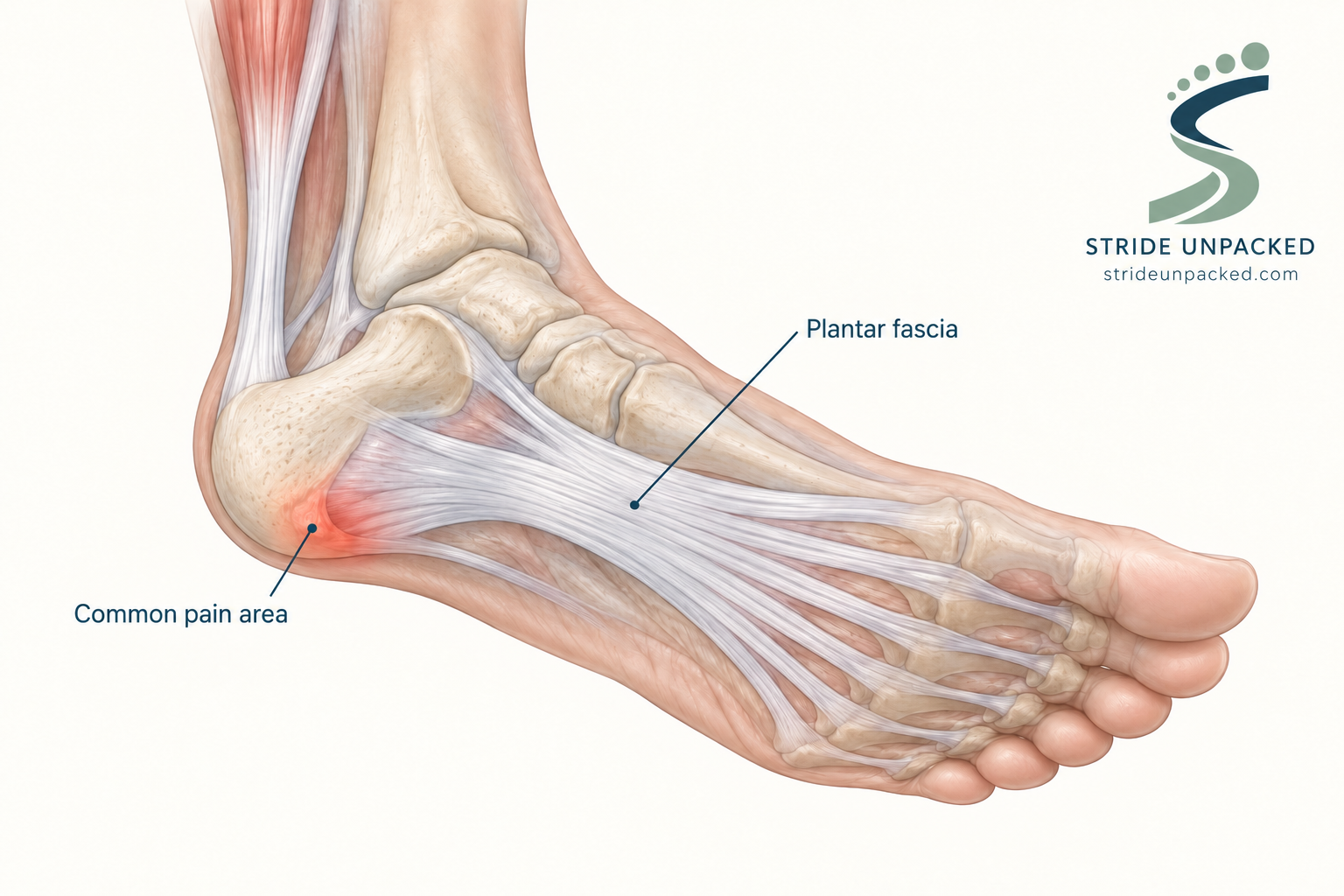
In clinic, I wouldn’t routinely tell someone with plantar fasciopathy—often called plantar fasciitis—to stop walking altogether. I would first want to understand their symptoms and whether the diagnosis fits.
Not all heel pain comes from the plantar fascia. If walking is becoming increasingly difficult or your symptoms are changing, don’t assume you simply need to push through.
For someone with plantar fasciopathy, the aim is usually to find a manageable amount of activity while working towards greater capacity.
How do I know whether I’m doing too much?
Consider three points: during your walk, afterwards and the following morning.
If walking does not noticeably aggravate your symptoms, you can walk without limping and your usual first-step pain is no worse the next morning, that suggests the amount may be tolerable.
It isn’t proof that nothing is happening within the tissue. Symptoms are useful feedback, rather than a precise measure of damage or healing.
Pain that builds during a walk, changes the way you walk or leaves you noticeably worse afterwards is a reason to adjust what you are doing. Don’t wait until the next morning if you are already struggling.
Keeping activity from making symptoms worse overall is consistent with NHS Inform’s guidance on plantar heel pain. [1]
How can I make walking more manageable?
Think about your walking time, pace and terrain, alongside the time you spend standing at work or at home. A short walk is only one part of your day’s activity.
Shorten the walk
Try reducing the distance or duration. Several shorter walks may be more manageable than one long walk, although their total still matters.
If a brisk pace aggravates your heel, ease back and see how it responds.
Choose a more manageable route
A flatter, even route may be easier to tolerate than hills or uneven ground. This is an adjustment to try, rather than a rule that everyone needs the same surface.
Use breaks when needed
Breaks can reduce continuous time on your feet. You may notice first-step pain when you stand up again, but that does not automatically mean the break has made the condition worse.
Judge the overall response, including whether your symptoms settle and how you feel later.
Consider your footwear
A comfortable, well-fitting shoe with cushioning and support may help. Think about what you wear indoors too: barefoot walking on hard floors can aggravate symptoms. These suggestions also appear in NHS plantar fasciitis guidance. [2]
There is no single shoe that suits everyone, and a more expensive shoe is not necessarily a better choice for you.
Stay active in other ways
If walking is aggravating your heel, another activity such as cycling may be more manageable. It still needs to suit your symptoms; an alternative activity is not automatically pain-free.
NHS Dorset’s guidance also suggests lower-impact activities as a way to maintain fitness. [3]
How do I build my walking back up?
Once your current amount feels manageable and your symptoms are reasonably settled, begin increasing the demands gradually.
My advice is to change one thing at a time.
You might walk a little longer while keeping your pace and terrain familiar. If returning to hill walking is your goal, you could instead keep the walk short while introducing a more challenging section.
Increasing distance, pace and difficulty together makes it harder to identify what contributed if your symptoms flare.
There is no universal number of steps or weekly increase that will suit everyone. Progression should reflect your starting point, goals and response.
What if I have a setback?
A noticeably worse response can suggest that an increase was more than you currently tolerate. Ease back towards an amount you were managing and reassess before increasing again.
Recovery is not always a straight line. One uncomfortable morning does not necessarily mean you have damaged the tissue or lost your progress.
Look at the broader pattern. Are you gradually walking further, managing daily activities more comfortably or recovering more easily afterwards?
New or changing symptoms should not automatically be dismissed as a routine flare-up.
When should I get assessed?
I recommend assessment if the location or character of your pain changes, symptoms become more severe, you start limping or your ability to manage normal activities declines.
It is also worth seeking help if you remain stuck. Being able to tolerate the same limited amount of walking is useful, but if pain and function are not meaningfully improving, your diagnosis and rehabilitation plan may need reviewing.
A short plateau does not necessarily mean treatment has failed. Equally, you should not feel you must keep repeating an approach indefinitely when it is not helping.
NHS guidance recommends seeking advice if heel pain has not improved after two weeks of self-care. That is a prompt to get help—not a deadline for complete recovery. Seek advice sooner for tingling, loss of sensation, or heel pain if you have diabetes.
Get urgent advice through NHS 111 if you cannot walk, have severe heel pain after an injury, your foot has changed shape, or you heard a snap or pop during the injury. Outside the UK, use your local urgent-care service. [4]
The aim is to help you keep moving at a manageable level and build towards the activities that matter to you, with an assessment when the picture is unclear or progress has stalled.
For more about first-step pain and other possible causes, read “Heel Pain in the Morning: Is It Plantar Fasciitis?” in the related articles below.
Sources & further reading
[1] NHS Inform: Plantar heel pain
This is general education, not a personal diagnosis or an individual treatment plan. Read our health information disclaimer.