Footwear & insoles / REVIEW
HOKA Bondi 9 Review: Why I Recommend It for Some Patients with Plantar Fasciitis
A podiatrist’s clinical perspective on the HOKA Bondi 9 for walking, standing and heel pain: patient feedback, useful features, limitations and who it may suit.
Why did I start recommending the Bondi?
My interest in the Bondi began with patients.
People were coming into clinic telling me that their HOKA Bondi trainers had made walking and standing more comfortable. That prompted me to look more closely at the shoe and how it suited the patients in front of me.
I recommended the Bondi 8 before moving on to the Bondi 9. My experience with the range therefore spans more than one version; the observations in this review concern the Bondi 9 unless stated otherwise.
Much of the feedback comes from people spending long periods on their feet, including nurses and care workers. For them, the priority is often getting through a working day more comfortably.
What do I like about the Bondi 9?
Cushioning
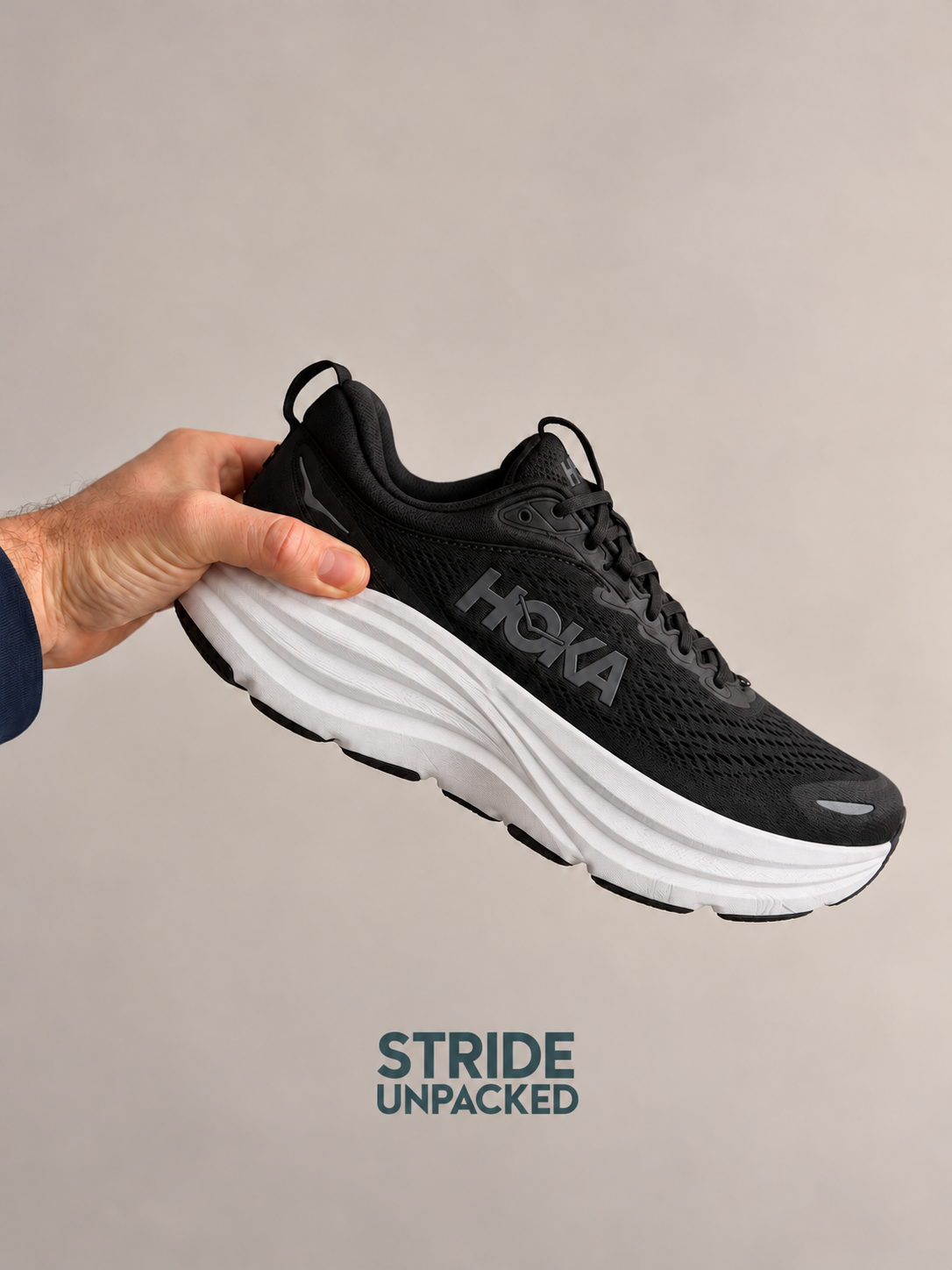
HOKA describes the Bondi 9 as a highly cushioned shoe, using supercritically foamed EVA in its midsole. [1]
When assessing footwear for someone with heel pain, I consider how comfortable the shoe feels during standing and walking. Some patients I recommend the Bondi 9 to report a substantial improvement in those activities.
That feedback is valuable, but it does not establish that cushioning alone caused the improvement or that everyone will respond similarly.
The rocker design
The Bondi 9 features HOKA’s Smooth MetaRocker. [1]
I consider a rocker design when I want the shoe to help accommodate the transition from heel towards toe. How this feels—and whether it helps—needs to be assessed on the individual.
My reasoning for choosing a rocker should not be confused with proof that the Bondi 9 specifically reduces plantar fascia loading or treats plantar fasciitis.
Its base and heel-to-toe drop
I find the relatively broad base useful when assessing how supported a patient feels in the shoe. Most patients I have recommended it to have described it as stable.
HOKA lists a 5 mm heel-to-toe drop. This is the difference in height between the heel and forefoot, rather than the total thickness of the sole. [1]
That specification helps describe the shoe. It does not, by itself, tell us whether it will suit your foot.
Who might it suit?
I most often consider the Bondi 9 for someone who:
- Finds walking or prolonged standing uncomfortable.
- Would benefit from trying a cushioned, rocker-style trainer following assessment.
- Can wear trainers for their usual activities.
- Finds the fit and feel comfortable when trying it.
Although HOKA markets it for running and walking, much of my clinical experience concerns everyday walking and standing at work. [1] Check that any shoe meets your workplace’s footwear requirements.
What are the limitations?
It is a chunky trainer
Some patients find the shoe bulky. Others simply prefer dressier footwear.
I always ask: “Would you actually wear something like this?”
If the answer is no, buying it makes little sense. A shoe sitting in the cupboard cannot help you.
Not everyone likes a rocker
Some people find the rolling sensation unfamiliar or unpleasant. That matters, even if someone else loves it.
I am particularly cautious when assessing footwear for a person with balance difficulties. I would want to assess their response rather than assume that a broad base makes the rocker suitable.
I have not personally wear-tested this model
I cannot offer a personal mileage test, long-term durability result or comparison from running in the Bondi 9 myself.
My perspective is clinical, supported by patient feedback. Those patients were selected for a recommendation, so their experience should not be treated as a prediction for every buyer.
What if I wear insoles?
Try the shoe and your prescribed insole together.
Check that the combination leaves enough room, holds your foot securely and does not create rubbing or crowding. Do not assume that choosing a cushioned trainer automatically makes an existing orthosis unnecessary.
Our guide to insoles for plantar fasciitis explains how I approach this decision.
Will the Bondi 9 fix my plantar fasciitis?
I would not describe it that way.
Some patients report much less pain while walking and standing in it. That can make daily life more manageable, but symptom relief from footwear is not the same as completing rehabilitation.
I use footwear alongside the other parts of an individual management plan. You can read more in our heel-raise exercise guide.
If your symptoms persist, repeatedly buying different trainers may not answer the underlying question. My preference is to understand the problem and what a footwear change is intended to achieve.
My verdict
The Bondi 9 earns its place among the shoes I consider because of my clinical experience and the feedback I receive from suitable patients.
It is worth considering if you want a cushioned, rocker-style trainer for walking and standing. But comfort, fit, suitability and willingness to wear it come before the brand name.
Other shoes may suit you equally well—or better.
View the Bondi 9 on Amazon
Affiliate links: I may earn a commission from qualifying purchases, at no extra cost to you.
View men’s HOKA Bondi 9 on Amazon (affiliate link)
View women’s HOKA Bondi 9 on Amazon (affiliate link)
Check the selected size, width, colour, seller and return conditions before ordering.
Keep building your understanding
Heel pain in the morning: is it plantar fasciitis?
Can I keep walking with plantar fasciitis?
How I tested it
I have assessed patients wearing the Bondi 9 in clinic and discussed their comfort during walking, standing and everyday activities. I recommended the Bondi 8 before the Bondi 9; that earlier experience is separate from this model. I have not personally worn or run in the Bondi 9 and have not performed a controlled comparison or a long-term mileage test. This is a clinical perspective informed by selected patients’ feedback and manufacturer specifications.
What works well
- Some selected patients report more comfortable walking and standing.
- Cushioning and rocker geometry are features I value when they suit the individual.
- Most patients I have recommended it to describe it as stable.
Things to consider
- A chunky design that some people find bulky.
- Not everyone likes the rocker sensation or trainer appearance.
- Balance difficulties warrant individual assessment.
- No personal wear test or durability assessment from me.
- Positive feedback from selected patients does not predict everyone’s response.
Sources & further reading
[1] HOKA: Bondi 9 specifications and intended uses (manufacturer information)
This is general education, not a personal diagnosis or an individual treatment plan. Read our health information disclaimer.