
Footwear & insoles / READ
Do Insoles Help Plantar Fasciitis—and Do You Need Custom Orthotics?
Could insoles help your heel pain, do you need custom-made orthotics, and how do you know they’re working? Dan Broadhead explains how he chooses and reviews insoles alongside rehabilitation.
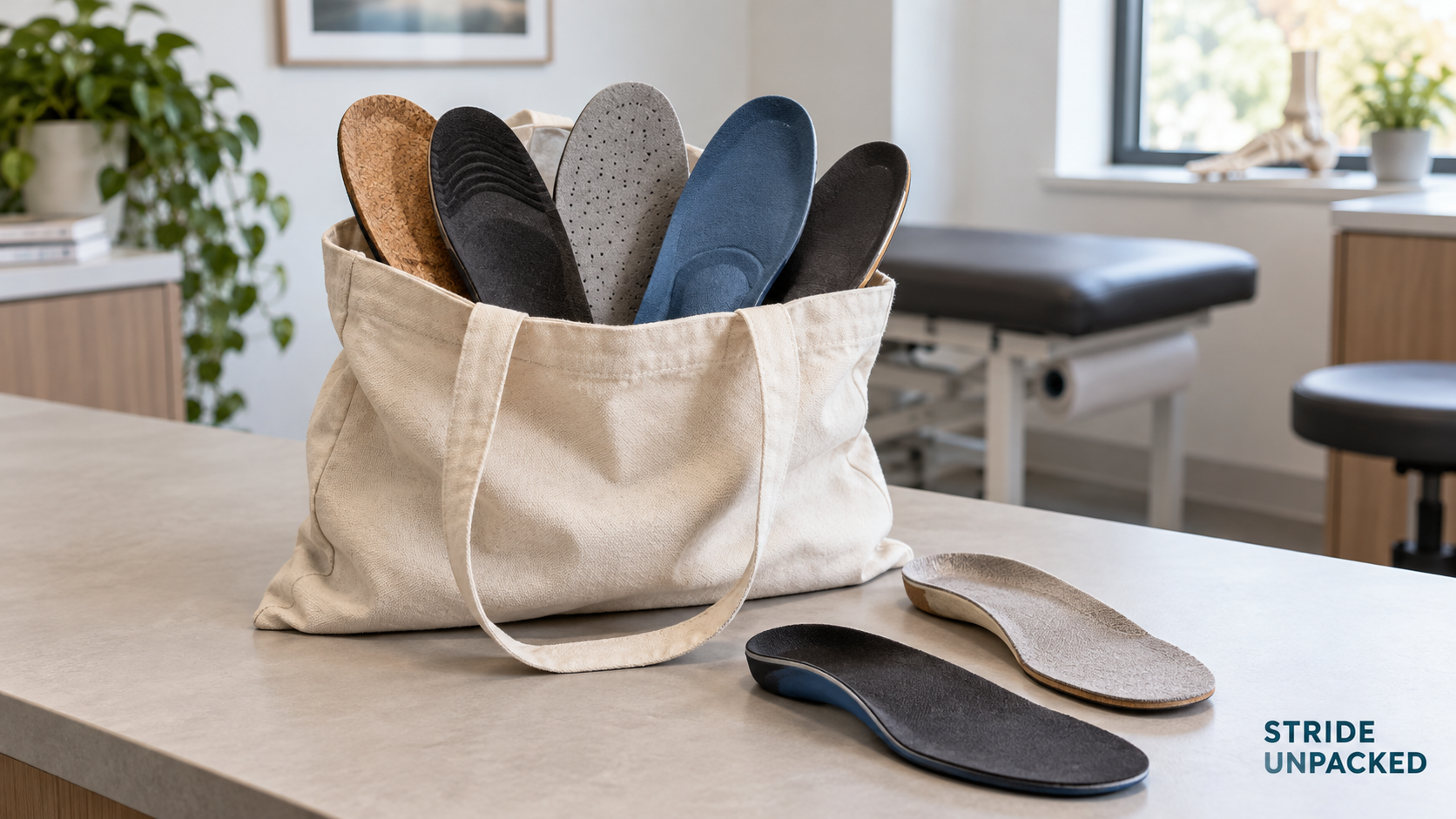
Cover image: AI-generated editorial image for Stride Unpacked.
Patients sometimes arrive in my clinic carrying a bag full of insoles. They’ve tried different shapes, materials and promises, but their heel still hurts.
Before recommending another pair, I want to know what the previous ones were supposed to achieve—and whether they helped.
If you’re considering insoles for plantar fasciitis, there are three useful questions: could they help your symptoms, do you need a custom-made pair, and how will you judge the result?
Could insoles help my plantar fasciitis?
My aim when prescribing an insole is to make standing and walking more manageable by changing how the foot is supported and loaded.
That might mean cushioning a sensitive area or redistributing pressure. An insole does not have to produce a visible change in your walking to be useful. Support and cushioning are both recognised purposes of foot orthoses. [3]
In clinic, I usually begin with rehabilitation and activity advice. If pain makes those difficult, I may introduce an insole earlier to help the person participate.
You do not have to exhaust every exercise option before an insole can be considered. Equally, buying an insole should not mean abandoning rehabilitation.
The 2023 clinical guideline supports considering orthoses alongside other treatments, rather than using them alone for short-term pain relief. It also recommends resistance exercises for the foot and ankle. [1]
For an example of how I approach strengthening, read our guide to heel raises.
Do I need custom-made orthotics?
Not automatically. In my practice, I rarely need a fully custom-made device for plantar fasciopathy. I can often find a suitable prefabricated option and adapt it where necessary.
There are three broad choices:
- Off-the-shelf insoles: ready-made products offering features such as cushioning or arch support.
- Customised prefabricated orthoses: ready-made devices that a clinician adjusts, for example through heat moulding or added components.
- Fully custom-made orthoses: individually manufactured devices based on an assessment and measurements or a representation of your foot.
I consider fully custom-made devices when someone’s foot shape, fit or prescription needs are difficult to accommodate with available alternatives.
Research also challenges the assumption that custom-made always means better. A randomised trial involving 135 people found similar effectiveness between the prefabricated and custom devices studied. That does not make every insole interchangeable, but it gives us reason to question whether a custom device is necessary. [2]
What do I use in clinic?
I often use heat-mouldable prefabricated orthoses, including Formthotics. I value being able to fit and adjust them to the person and their footwear. Heat moulding and additional modifications are features described by the supplier. [4]
This is my clinical preference, rather than evidence that one brand is best for everyone.
Disclosure: I have occasionally been paid for my time presenting training courses for Formthotics UK. I retain control over what I say and can discuss other products. I purchase the products I use in clinic; they are not gifted to me.
Check the footwear before buying
I ask patients to bring the shoes they actually wear. Adding an insole takes up space, so I check for crowding, pressure and whether the foot remains secure.
A bulky device is little use if it only fits shoes someone never wears. We may need a different device, an adjustment or a conversation about footwear.
Before buying, ask what the insole is intended to do, whether it fits your shoes, and what adjustment or return options exist if it does not suit you.
How will I know whether they’re helping?
Look for a useful change in your everyday life.
When reviewing someone, I want to know:
- Is standing at work more manageable?
- Can they walk more comfortably?
- Is their usual first-step pain improving?
- Can they participate more comfortably in rehabilitation?
- Has discomfort appeared somewhere else?
Feeling supported is useful feedback, but I also want to understand whether the activity that brought them into clinic is getting easier.
Build up wear gradually
Follow the wearing-in advice supplied with your orthoses. I usually recommend starting with short periods of standing and walking, then increasing according to the response, including how the foot feels the following day.
An hour pottering at home is different from an hour of continuous walking at work.
Gradual introduction is also recommended in NHS guidance. Persistent discomfort may mean the device needs adjusting; severe pain is a reason to stop wearing it and contact the supplying clinician. [3]
Check for rubbing or skin damage too. If these develop, stop using the device and seek advice. [5]
For runners, comfortable everyday use comes first. Any return to running should also fit the injury’s rehabilitation plan.
Set a review point
If an insole feels wrong or causes new symptoms, I want to hear about it early.
If it is comfortable but has not helped, I usually review progress within a few weeks—often around three to four weeks in my practice. That is a review point, not a recovery deadline.
We may need to adjust the device, reconsider the footwear, review the exercises or check the diagnosis. Repeatedly buying another pair without understanding why the previous ones failed can leave you with that familiar bag of insoles.
Will I need them forever?
When an insole supports injury rehabilitation, I review whether its use can be reduced as symptoms and function improve. Some people continue to find it useful for running or longer walks.
Others need ongoing support for a longer-term foot problem. NHS guidance recognises that some people continue using insoles indefinitely, while others can stop following recovery and review. [3]
Being comfortable and active matters more than meeting an arbitrary deadline for stopping them.
When should I get my heel pain assessed?
If you have tried several insoles without improvement, get the cause of your heel pain and the treatment plan reviewed.
My three-to-four-week review point refers to someone already following an assessed plan. You do not need to wait that long to seek help.
NHS guidance recommends assessment if heel pain has not improved after two weeks of self-care, is worsening or is interfering with normal activities. Seek advice for tingling or reduced sensation, or if you have diabetes and foot pain. [6]
Keep building your understanding
Heel pain with your first steps: could it be plantar fasciitis?
Can I keep walking with plantar fasciitis?
Plantar fasciitis exercises: a guide to heel raises
How long does plantar fasciitis take to get better?
This article combines my clinical experience with published evidence and guidance. It cannot establish the cause of your heel pain or replace an individual assessment.
Sources & further reading
[1] Heel Pain—Plantar Fasciitis: Clinical Practice Guideline, 2023
[2] Landorf and colleagues: Effectiveness of foot orthoses to treat plantar fasciitis, 2006
[3] Guy’s and St Thomas’ NHS Foundation Trust: Foot insoles
[4] Formthotics UK: Fitting and product FAQs (supplier information)
This is general education, not a personal diagnosis or an individual treatment plan. Read our health information disclaimer.