Heel & Foot / READ
Do Bunion Correctors Actually Work? Toe Separators, Splints and Realistic Expectations
Dan Broadhead explains when toe separators may ease bunion symptoms, why joint flexibility matters, and what braces and splints can realistically achieve.
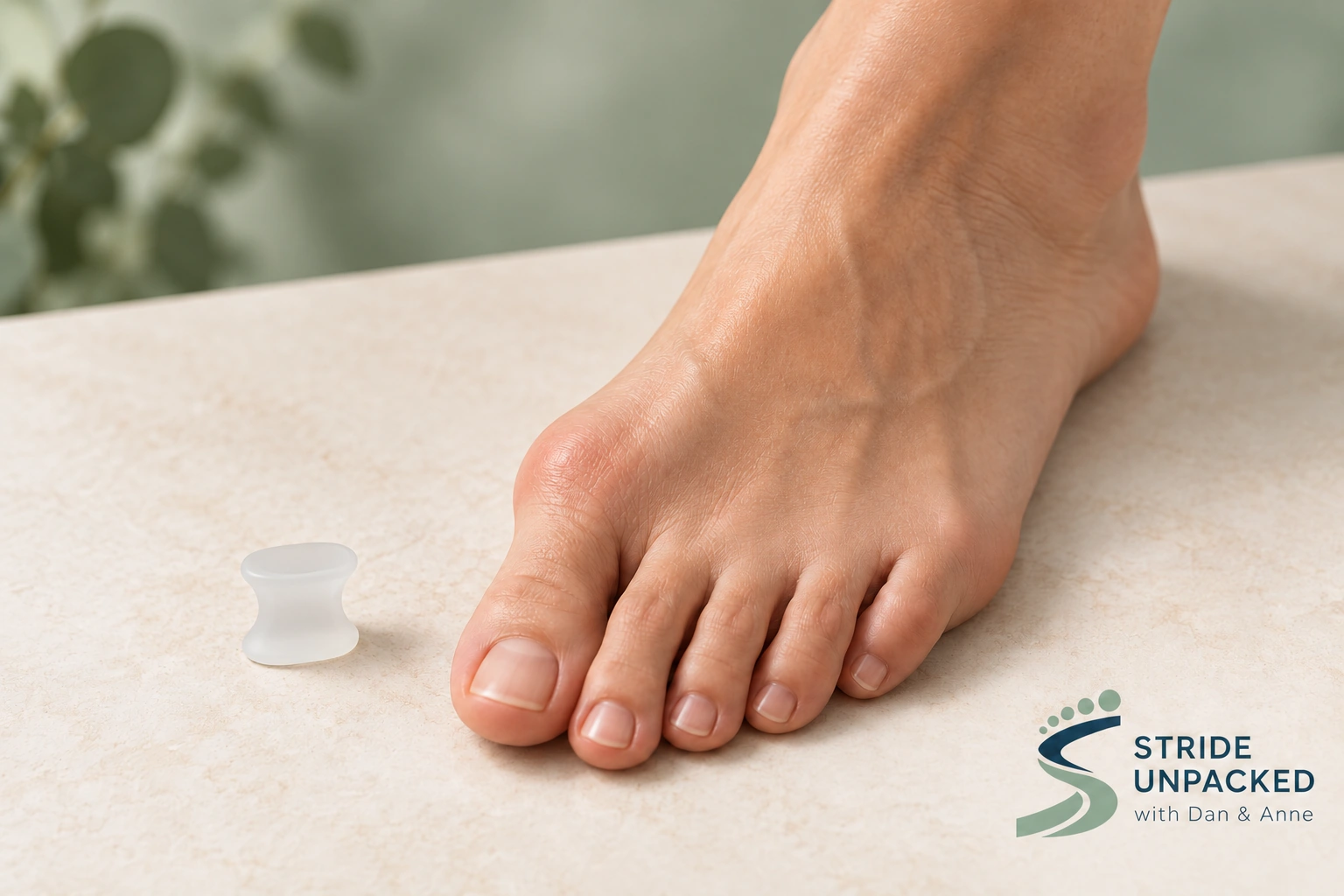
If you search for help with a bunion, you will quickly find products promising to straighten your toe. Some are simple gel separators. Others are straps, braces or larger night splints. The word “corrector” can make them sound like a permanent solution.
In my clinic, I sometimes recommend a toe separator to help with discomfort. But I make a distinction between making a foot more comfortable and permanently changing the bunion. The right device depends on the person, the movement available at the joint and what is actually causing the pain.
Can a Toe Separator Correct a Bunion?
A separator sits between neighbouring toes. In someone with a mobile big-toe joint, it may hold the toe in a more comfortable position while it is worn. It can also reduce contact between the big toe and second toe.
That is not the same as reliably reversing a bunion. In my experience, the toe commonly returns towards its previous position when the device comes out. I recommend these devices for a possible improvement in comfort, not with a promise of permanent straightening.
The research deserves a fair explanation. A 2021 systematic review found that some orthoses, particularly designs incorporating a toe separator, improved pain and reduced the measured hallux valgus angle. However, the studies were limited and used different devices and methods. These findings do not establish that an off-the-shelf separator permanently corrects a bunion after treatment stops. [1]
AAOS guidance similarly notes that braces and splints have not been shown to permanently fix bunions. Symptom relief may still be worthwhile. [2]
First, Is It Definitely a Bunion?
A prominence beside the big-toe joint does not tell us everything. Hallux valgus involves a change in alignment, with the big toe moving towards the smaller toes. An arthritic joint can also develop a bony prominence, sometimes without that same deviation.
Before recommending a device, I assess the alignment, movement and source of pain. I also look at the skin and the neighbouring toes. That helps us decide whether a separator is likely to help or simply introduce pressure somewhere else.
Our article Is It a Bunion or a Bony Lump? explains that distinction. If bending the joint is the main problem, see Why Does My Big Toe Hurt When I Bend It?.
When Do I Find Separators Helpful?
There are two situations where I may consider one:
- The big toe can move into a more comfortable position, reducing discomfort around the joint.
- The big toe and second toe are pressing against each other, causing rubbing or irritation.
Reducing that contact may help with pressure associated with corns and calluses. A separator does not remove an existing corn or replace assessment of damaged skin. Anne explains why pressure matters in Painful Corn on Your Toe?.
The response is individual. Some people notice useful relief; others find that a separator adds bulk or creates new discomfort. A device that helps one person may be unsuitable for another.
Why Joint Flexibility Matters
In clinic, I gently assess whether the big toe can move towards a straighter position. I do not ask patients to force it into place.
If the bunion is relatively flexible, a suitable separator may help hold a more comfortable position. If the joint is quite fixed, the same device may push the second toe towards the third instead of moving the big toe as intended.
That is a concern I look for during fitting. We should not improve the appearance of one gap by creating pressure in another. The aim is comfort and function across the forefoot, not a perfectly straight toe at any cost.
Does Separator Thickness Make a Difference?
Yes—in my clinical experience, the amount of separation can matter as much as the choice to use a separator at all.
A thicker device is not automatically better. Trying to achieve full straightening may be uncomfortable, whereas a smaller change in position may help symptoms.
If one device is unsuitable, that does not prove every separator will be unsuitable. A different shape or thickness may be worth discussing with your podiatrist. However, do not keep increasing the size or pushing through pain in pursuit of correction.
What About Night Splints and Larger Bunion Correctors?
Patients have often told me that larger bunion correctors feel uncomfortable. In my own practice, I have not found them particularly useful overall.
That is my clinical experience, rather than proof that nobody benefits. If a properly fitted device provides symptom relief without causing another problem, that benefit can matter to the person using it.
What I would not promise is lasting correction of the bunion or toe position. A product photograph showing a straight toe inside a brace does not demonstrate what happens after it is removed.
How Should You Try a Separator Safely?
I recommend professional guidance before choosing one, particularly if you are unsure whether the problem is a bunion or whether the joint can move comfortably.
Once a device has been judged suitable, follow its fitting and care instructions. Check both how it feels and what is happening to the skin. There is no single wearing schedule that suits every foot and every device.
Remove it if it causes joint pain, rubbing, skin irritation, numbness or a change in toe colour. Check the surfaces where it touches the big toe and second toe, as well as whether the smaller toes are becoming crowded.
Moisture can collect between toes. If the skin becomes pale, soggy or irritated, stop using the device and seek advice. Keep the skin and device clean and dry, and follow the manufacturer's cleaning instructions. Do not assume an “antimicrobial” product description means the skin cannot develop irritation or infection.
Footwear still matters. The shoe needs enough width and depth for your foot and the separator without squeezing the toes together. A device cannot compensate for a shoe that compresses it against the skin. NHS inform includes appropriate footwear and pressure relief among the practical measures that may help bunion symptoms. [3]
Who Needs Particular Caution?
If you have diabetes, reduced feeling in your feet, poor circulation or broken skin, seek advice from a qualified healthcare professional before trying a separator or splint.
A device can cause damage or create another problem. Reduced sensation is particularly important because pain may not reliably warn you that something is rubbing. Do not use a separator to cover or manage a wound yourself.
A suddenly hot, swollen, painful joint or spreading redness needs prompt medical assessment rather than another device. Seek urgent help if you have signs of infection, discharge or feel unwell. A new foot wound in someone with diabetes needs prompt professional attention. [4,5]
A Separator I Commonly Recommend
Different people may need different devices. One option I commonly suggest patients consider is a Silipos gel toe separator, after assessing whether separation is appropriate for their foot.
We previously stocked Silipos separators in our clinic. We no longer sell them and now direct patients to Amazon, which we have found to be a cost-effective purchasing option. Prices and sellers vary, so that is not a guarantee that it is always the cheapest source.
View Silipos Gel Toe Spreaders on Amazon — affiliate link
The listing supplied for this article is the medium version. That is not a recommendation that everyone should choose medium: size, shape and comfort need to suit the individual. This is a clinical recommendation within an advice article, not a personal wear-test or a claim that this product outperforms every alternative.
What If a Separator Does Not Help?
I go back to the source of the pain.
If the problem is footwear pressing against the prominence, we reassess shoe fit and pressure relief. Padding may help where there is enough room, but adding material inside an already tight shoe can increase pressure.
If pain comes from within the joint, particularly when it moves, that needs assessment in its own right. Depending on the diagnosis and the person's medical history, symptom management may include a suitable topical anti-inflammatory. A pharmacist or clinician can advise whether that is appropriate.
For selected patients, a clinician may discuss a corticosteroid injection—for example, where arthritis is contributing to joint pain and stiffness. This has potential risks as well as benefits and is not a routine treatment for every bunion. It will not straighten the toe. [6]
If appropriate non-surgical measures have not provided enough relief and symptoms continue to affect daily life, referral to orthopaedics or podiatric surgery may be appropriate. Surgery requires an individual discussion of benefits, recovery and complications; it is not simply the next purchase after an unsuccessful separator. [4,6]
What I Want Patients to Take Away
A toe separator may be a useful tool for symptom relief. It should make the foot more comfortable without damaging the skin or creating pressure on another toe.
I am more interested in whether you can walk comfortably than whether a device holds your toe perfectly straight. Get the problem assessed, set realistic expectations and choose the device around your foot—not around a promise on the packaging.
Product and Affiliate Disclosure
We previously stocked Silipos toe separators in our clinic but no longer sell them. We now direct patients to Amazon, which we have found to be a cost-effective option. Prices can vary.
We have no commercial relationship with Silipos. The Amazon link is an affiliate link, so we may earn a commission from qualifying purchases at no additional cost to you. As an Amazon Associate, we earn from qualifying purchases.
This is a product Dan recommends in clinical practice. The appropriate device and size depend on the individual; it is not suitable for everyone.
Sources & further reading
1. Kwan et al. (2021): Hallux valgus orthosis characteristics and effectiveness
This is general education, not a personal diagnosis or an individual treatment plan. Read our health information disclaimer.