Heel & Foot / READ
Why Does My Big Toe Hurt When I Bend It? Hallux Limitus and Rigidus Explained
Dan Broadhead explains painful, stiff big-toe joints, how they differ from bunions, and where footwear, orthoses, gentle movement and surgical advice fit in.
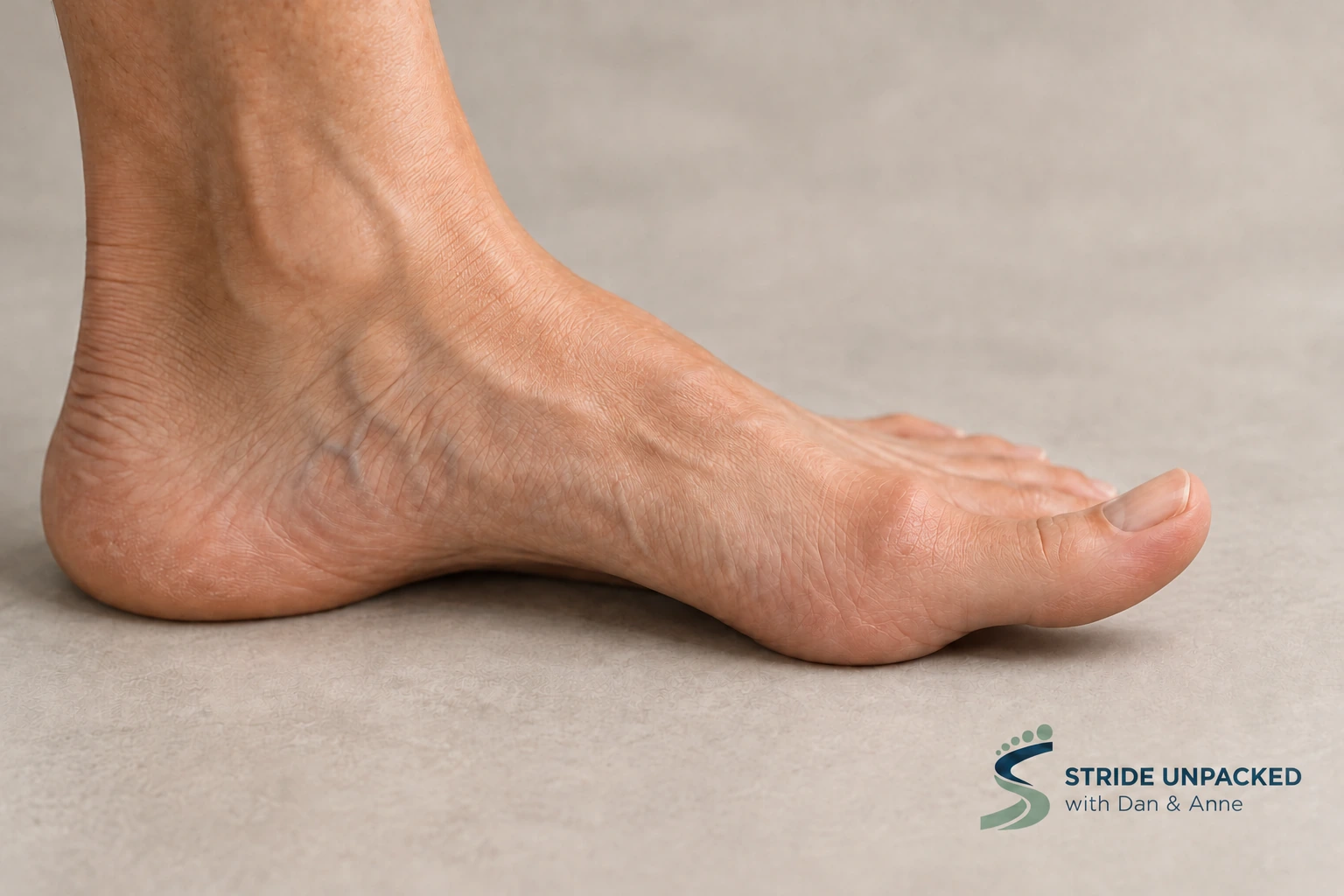
A sharp pain as you push off your big toe can change the way you walk. You might notice it when climbing onto your toes, wearing a heel or trying to bend the toe upwards. After a busy day, the joint may ache even when you sit down.
In clinic, patients often point to the large joint at the base of the big toe—the first metatarsophalangeal joint, usually shortened to the first MTP joint or MPJ. The pain is often on top, although discomfort underneath needs investigating too.
A stiff, painful joint can be associated with hallux limitus or hallux rigidus. But the first step is finding out what is causing the pain, rather than assuming that every sore big toe needs the same treatment.
When Should I Get Urgent Help?
A suddenly painful, hot, swollen joint needs urgent medical assessment, particularly if it is red, getting worse or making walking difficult. Redness can be harder to see on darker skin. Gout can first appear in the big-toe joint, but infection can look similar. Do not assume it is ordinary arthritis or try to settle it with a new shoe alone. [1]
Contact your GP urgently or NHS 111, especially if you also feel unwell, feverish or shivery. Significant pain following an injury also needs assessment. Do not wait for a routine footwear appointment.
What Are Hallux Limitus and Hallux Rigidus?
“Hallux” means big toe. Hallux limitus describes restricted movement at its base joint. Hallux rigidus is commonly used for arthritis causing stiffness in that joint; despite its name, it does not always mean there is absolutely no movement left. [2]
In my clinic, I explain these problems through the movement available and what that means for the person. Can they walk comfortably? Does the toe bend enough for the activities they want to do? Where does pain begin?
I am particularly interested in dorsiflexion—the toe bending upwards. I do not base a treatment plan on a single angle. Movement measurements need to be considered alongside symptoms, the examination and how someone walks.
Some people have very little movement but relatively manageable symptoms. Others have more movement yet find it painful. A stiff joint is not automatically a painless joint, and the degree of stiffness alone does not tell us what treatment someone needs.
Why Does It Hurt When I Bend My Big Toe Upwards?
One possible explanation is osteoarthritis, where changes to the joint surfaces and extra bone around the joint can make movement uncomfortable. A bony prominence on top may contribute to pain as the toe bends upwards. [2]
In clinic, I ask whether discomfort appears only at the end of the movement or throughout it. I also look for tenderness around the joint and irritation from footwear.
Patients sometimes describe a sharp, catching pain when pushing off, followed by an ache after spending time on their feet. A heeled shoe can make symptoms more noticeable because of the position it puts the toe in.
However, pain in this area is not enough to establish the diagnosis. The pattern, the examination and any appropriate imaging all matter.
Is It a Bunion Instead?
A bunion and a stiff big-toe joint are different problems, although they can occur together.
With hallux valgus, the big toe angles towards the smaller toes, usually with a prominence on the inner side of the joint. With hallux limitus or rigidus, restricted joint movement is a central concern. A prominence on top of an arthritic joint is another possible finding. [2,3]
I see patients with bunions who still have very good movement. I also see patients with a straight big toe and a restricted, painful joint. A lump on its own does not tell the whole story.
During an assessment, I look at alignment and movement separately. We can then discuss what is actually causing the discomfort rather than treating every bump as a bunion.
If it is your smaller toes that are curling, Anne explains those different problems in Hammer, Claw and Mallet Toes.
What Do I Check in Clinic?
I assess how far the toe moves, where it hurts and whether pain occurs when the patient moves it themselves, when I gently move it, or both. I also want to know about previous injuries, footwear and the activities that bring symptoms on.
Pain underneath the joint can involve different structures, including the sesamoids—the two small bones beneath the first metatarsal head. A recent injury raises different questions again. Tendon problems can also affect active movement. These are reasons to examine the foot rather than diagnose it from a photograph or the location of pain alone.
I sometimes use diagnostic ultrasound in my clinic to look at the joint capsule, nearby soft tissues and other relevant findings. Increased blood flow on a scan can support the assessment of an irritated area, but it is not a diagnosis on its own.
X-rays are commonly used to assess arthritic changes, joint space and bony prominences. Ultrasound is not a substitute for every question an X-ray can answer. [4]
Can a Rocker-Sole Shoe Help?
Footwear is often my first practical recommendation once we have established the cause of the symptoms.
A rocker sole has a curved shape that helps the foot roll forwards. The aim is to reduce how much the painful big-toe joint needs to bend during walking. A suitably stiff sole can also be helpful. These are recognised footwear options for a stiff, arthritic big-toe joint. [4]
In my practice, I often find that a suitable change of footwear makes a worthwhile difference to comfort and function. It does not reverse arthritis or guarantee pain relief.
HOKA Bondi, selected Saucony Endorphin models and Joya footwear are examples I discuss with patients. These are starting points for a footwear conversation, not a recommendation for every model or every person. The shape, fit and stability of the individual shoe matter.
I do not have a preferred brand for everyone. I want the patient to find something that helps and that they will actually wear.
When trying footwear, I look for:
- Enough width and depth so the upper does not press on a tender joint or bony prominence.
- A secure fit that feels stable when walking.
- A sole that reduces painful bending without creating discomfort elsewhere.
- Comfort during a realistic walk in the shoe, rather than relying on appearance or a brand name.
If balance is a concern, I would assess the footwear carefully rather than automatically recommending a pronounced rocker.
For more about how I assess shoe fit, cushioning and rocker soles, see What Are the Best Shoes for Plantar Fasciitis?. That guide addresses a different condition, but explains the footwear features we discuss in clinic.
Where Do Insoles and a Morton’s Extension Fit In?
Sometimes changing shoes is not practical. A rugby player, for example, still needs to wear boots for their sport.
In selected cases, I use an orthosis with a Morton’s extension: a stiffer section beneath the big toe that limits how much it bends. Materials and stiffness vary according to the device and the aim of treatment.
This changes how the foot moves and loads during activity. That can be useful, but it can also create pressure or discomfort elsewhere if the setup is unsuitable. I would check the fit, the footwear and the patient’s response rather than recommend the same insert to everyone.
Personally, I often find footwear gives me more scope to improve comfort than an insole alone. That is my clinical approach, not a claim that footwear always outperforms orthoses.
My guide to insoles explains how I choose and adapt orthoses for individual patients. It focuses on plantar heel pain, so its rehabilitation advice should not be treated as a programme for a painful big-toe joint.
Should I Stretch or Mobilise a Stiff Big Toe?
My aim is to maintain comfortable movement where possible while reducing repeated painful bending during everyday activity.
After assessment, I may use or advise gentle mobilisation. I would not ask someone to force a painful joint upwards, twist it aggressively or try to stretch through a firm bony restriction.
There is a difference between maintaining the movement a joint can comfortably use and trying to force it to move beyond its available range. Mobilisation will not remove a bone spur or restore worn cartilage.
The purpose of a rocker sole or a suitable orthosis is not necessarily to stop all movement. It is to reduce the demand placed on the joint while walking. I also aim to help patients stay active through sensible adaptations rather than assume that a stiff toe means giving up exercise altogether.
What About Anti-Inflammatories or Injections?
I separate managing current symptoms from changing what repeatedly provokes them.
Depending on the assessment, options may include an anti-inflammatory gel, a discussion with the GP about medication, or a corticosteroid injection. These treatments require an individual suitability check. An injection may reduce symptoms, but it does not cure the underlying arthritis. [3,4]
I would not give readers a standard medication course to follow. Other medicines, medical conditions and the possibility of infection all affect the decision. Discuss the benefits and risks with the prescribing clinician.
Even if treatment settles the pain, I still look at footwear and activity. Feeling better temporarily does not necessarily mean the joint will tolerate exactly the same demands as before.
When Would I Discuss Surgery?
I explain the wider options early so patients understand the possible direction of treatment. If pain and limitations remain unacceptable despite suitable nonsurgical care, I would discuss a surgical opinion. Not everyone needs every medicine or an injection before referral is appropriate.
The operation depends on the joint, symptoms, activity goals and the surgeon’s assessment. Options can include:
- Cheilectomy: removing a bony prominence, usually when the pattern of arthritis makes a joint-preserving procedure appropriate.
- Fusion: joining the bones across the affected joint to reduce pain. Movement at that joint is lost, but the aim includes improving function and comfortable walking. Footwear and sporting goals need discussion.
- Joint replacement or an implant: an option for selected patients, with benefits, limitations and durability depending on the procedure and implant. It should not be presented as a guaranteed restoration of normal movement. [3,4]
Joint implants are described by NHS services, so it would be incorrect to say all big-toe replacements are private-only. Local availability and individual suitability vary. [4]
Surgery is a decision to make with the surgical team, including discussion of recovery, infection, persistent pain, failure of a fusion to unite and the possibility of further surgery. Referral is a chance to understand the options; it is not a commitment to an operation. [3]
What Is the Main Thing to Remember?
If your big-toe joint is painful and stiff, find out why before treating it as a footwear problem.
Once urgent causes have been excluded and the problem assessed, my practical priority is often to reduce painful bending during walking. A suitable rocker-sole shoe can be one way to do that. The right choice is the shoe or device that helps you function comfortably—not simply the one with a particular logo.
Maintain comfortable movement where appropriate, avoid forcing the joint into pain, and seek reassessment if symptoms change or the plan is not helping.
Keep Building Your Understanding
For one of the shoes I discuss in clinic, read my HOKA Bondi 9 clinical review. That review focuses on plantar heel pain; it is not a trial showing that the shoe treats big-toe arthritis.
You can also browse Recommended Kit for product information and clearly labelled retailer links, or meet Dan and read about his clinical background.
This article provides general education and does not replace an individual assessment, diagnosis or treatment plan. Read our health information disclaimer.
Sources & further reading
2. AAOS: Hallux Rigidus (Stiff Big Toe)
3. Royal National Orthopaedic Hospital: Arthritis of the Big Toe
4. Chelsea and Westminster Hospital: Management of Hallux Limitus
This is general education, not a personal diagnosis or an individual treatment plan. Read our health information disclaimer.