Walking & Running / READ
Why Do I Keep Getting Blisters When Running or Walking?
Podiatrist Dan Broadhead explains why foot blisters keep coming back, what helps with shoes, socks and taping, how to protect a blister, and when to get advice.
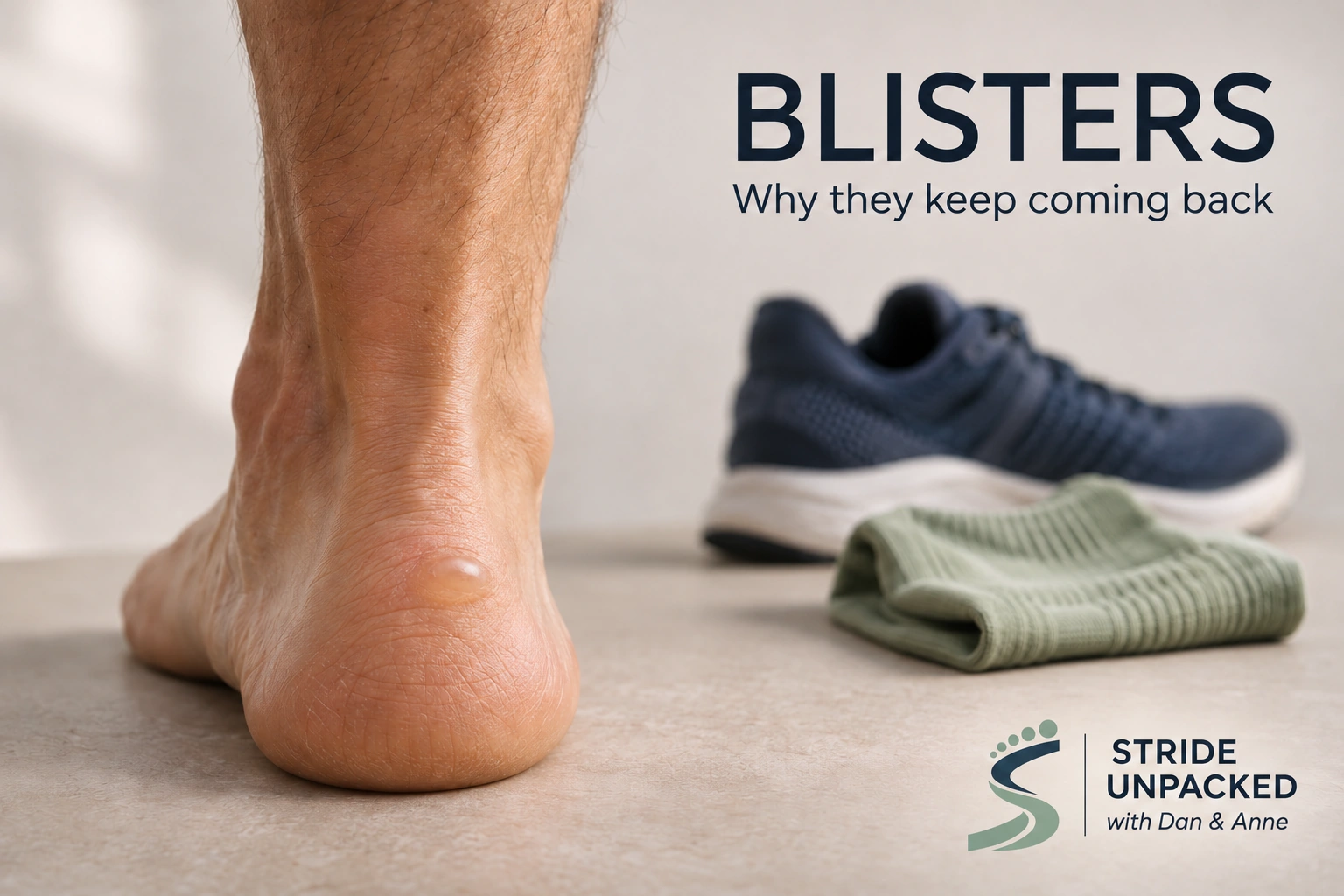
Blisters can turn a comfortable walk or run into something you just want to finish. If they keep returning, my first question is not which plaster to buy. It is why that particular area of your foot keeps getting irritated.
In my clinic, I commonly see blisters between the toes, at the ends of the toes and behind the heel. I see them underneath the foot less often, although the sole is also a recognised site. The pattern helps guide the assessment, but it does not tell the whole story. Blisters at the ends of the toes can also be more likely if the toes are curling or clawing.
This article contains affiliate links to product types I use in clinic. If you buy through those links, I may earn a commission. That does not change the price you pay, or the evidence discussed below. Those links are advertising, and each one is marked (Ad). You do not need to buy a product to follow this guide, and similar products from other brands are fine.
I also use, recommend and sell some of these products in clinic, so I have a commercial interest in their sale. I receive no free products, payments or support from the brands.
This is general information, not a diagnosis or personal medical advice.
Why do blisters form?
A friction blister develops when repeated shearing damages the skin and creates a small separation within it. Fluid then collects in that space. Friction between your foot, sock and shoe contributes to this process; it is more than simply rubbing away the skin's surface. [1]
A tender or stinging “hot spot” can be an early warning. It does not mean the blister is a heat burn. Continuing to expose the same area to repeated stress can allow the injury to develop further.
This helps explain why shoes can feel fine on a short outing but become troublesome over a longer distance. There are more steps and more repeated loading of the same area. Damp skin and changes in fit can add to the problem. [1,2]
In practice, I also ask whether feet have swollen during the outing, whether socks have creased or bunched, and whether anything has changed since the last comfortable run or walk.
What I ask when blisters keep coming back
Two people with a blister in the same place may need different advice. I want to know:
- Are you walking, running or doing another activity?
- Which shoes and socks are you wearing together?
- Does it happen during a short outing or only after a considerable distance?
- Is this a recurring pattern or a new problem?
- Have you changed footwear, socks, training distance or conditions?
Previous blistering is relevant. Research in trail ultramarathon runners has found that a history of blisters is associated with further episodes, although those findings do not predict exactly what will happen to an individual walker or runner. [3]
If blistering is unexplained, persistent or happening without an obvious activity-related trigger, it needs assessment rather than an assumption that every blister is caused by shoes.
Start with mechanics, shoe fit, lacing and socks
My first step is to assess whether foot function is concentrating stress in a particular area. That might include irritation around the big-toe joint or along the side of the big toe. If the joint looks different, or it hurts to bend the toe, see our guides to bunions and bony lumps and pain when you bend the big toe. Depending on what I find, footwear changes or an orthosis (an insole or similar device) may be worth considering.
That does not mean everyone with blisters needs insoles. I use them selectively when there is a reason arising from the assessment. Direct evidence that orthoses prevent friction blisters is limited. [1]
Next, I look at the shoe itself. Too little room can compress the toes or a prominent area. A painful corn can keep rubbing in the same place. Too much movement inside a shoe can also be a problem. Simply buying a bigger size is not always the answer: the foot needs sufficient space and appropriate security.
Lacing can help adjust how securely a shoe holds the foot. I may change the lacing pattern when someone is sliding around inside it, but tightening the laces excessively is not the aim. The adjustment should improve comfort without introducing pressure elsewhere. These are practical fitting measures; research has not established that a particular lacing technique reliably prevents blisters. [1]
Finally, I consider socks as part of the complete shoe-and-foot combination. Their fit, seams, cushioning and any tendency to bunch all matter to the individual wearing them. Damp skin increases friction, so a moisture-wicking or synthetic sock, and changing out of a wet pair, is a reasonable first step. [1, 2, 5] Cotton holds moisture for longer. That is practical advice from NHS and clinic experience, not a claim that one brand of sock will stop blisters. Evidence is strongest for densely padded acrylic socks; studies of double-layer socks have been mixed, and toe socks have not been adequately tested. [1] I would not rely on talcum powder or antiperspirants to prevent blisters. The evidence does not support them, and powder can become abrasive when it gets wet. [1]
Do toe socks help?
I often recommend considering Injinji toe socks, with the model chosen around the person and activity. I do not have one pair that I prescribe for every runner or walker.
WHERE TO BUY
Injinji Trail Midweight Mini-Crew socks
View on Amazon (Ad)Affiliate link: I may earn a commission if you buy, at no extra cost to you. As an Amazon Associate I earn from qualifying purchases.
Check the size and colour selected before ordering. You do not need this particular pair, and similar toe socks from other brands are fine.
The individual toe sections place fabric between neighbouring toes. I find this a useful option when toe-to-toe contact is part of the problem, but it still needs to feel comfortable within the shoe. Extra material should not leave the toes crowded.
My recommendation is based on clinical experience, not proof that toe socks prevent blisters in everyone. The research has not adequately established their blister-prevention effectiveness. [1]
Anne explains her own running preferences in Injinji vs Feetures: A Podiatrist’s Running Sock Review. Her personal experience is useful context, rather than a guarantee that the same pair will suit you.
What should you do at the first hot spot?
If you can stop safely, check what is happening before it becomes a bigger problem. Look for a folded sock, debris, a tight area or excessive movement. Addressing the cause matters more than covering it and carrying on unchanged.
For an early hot spot where the skin is still intact, I commonly recommend zinc oxide tape. SPORTTAPE is a brand I use and like, particularly its adhesion and choice of widths. Hypafix or Mefix are alternatives I sometimes consider; in my experience they offer less robust protection in this setting.
WHERE TO BUY
SPORTTAPE zinc oxide tape
View on Amazon (Ad)Affiliate link: I may earn a commission if you buy, at no extra cost to you. As an Amazon Associate I earn from qualifying purchases.
The link is to a 3.8 cm tan roll, which is a versatile width for the foot. Other widths are available. You do not need this particular brand.
That comparison is my clinical judgement. There is not good comparative evidence establishing zinc oxide tape as superior to those products for blister prevention. Research on paper tape cannot automatically be applied to every adhesive tape. [1]
Taping should be smooth, without folds or tight wrapping around a toe or foot. Follow the product instructions, avoid products to which you are sensitive, and stop using tape if it irritates the skin. Adhesive tape should not be placed directly on an exposed blister wound. If you have diabetes, poor circulation or reduced sensation, get advice before self-taping.
For someone who regularly blisters in the same place, I prefer planning ahead and testing suitable protection during training rather than trying a new approach for the first time during an event.
If the blister is intact
I would generally leave a smaller blister intact and protect it. Do not deliberately burst it yourself. For a large, tense, painful blister, I would drain it with a sterile needle and leave the roof on as a natural dressing. A GP or another clinician can do the same. That is a clinic treatment, not something to try at home, particularly if you have diabetes, poor circulation or reduced sensation. Reduce the friction causing the problem and choose a suitable protective dressing. [2]
Hydrocolloid blister dressings, such as Compeed, are an option I recommend for ordinary walking and sometimes running. Many of my patients use them successfully. NHS guidance recognises hydrocolloids as an option for protection, pain relief and healing. [2]
WHERE TO BUY
Compeed mixed-size blister plasters
View on Amazon (Ad)Compeed blister plasters for toes
View on Amazon (Ad)Affiliate links: I may earn a commission if you buy, at no extra cost to you. As an Amazon Associate I earn from qualifying purchases.
A mixed pack covers more than one site; the smaller toe-shaped plasters can be useful when the blister is on a toe. You do not need this particular brand.
Follow the instructions for the exact product. Compeed advises leaving the dressing until the edges start lifting and, when removal is needed, stretching it gently along the skin rather than pulling upwards. Do not cut the plaster, as that can reduce how well it stays in place. Strongly adherent dressings need careful removal. [4]
If you have diabetes, poor circulation or reduced sensation, do not self-treat with a hydrocolloid plaster. Compeed advises people with diabetes not to use its blister plasters unless a clinician has agreed. [4] Seek advice first, as set out below.
I am more cautious about hydrocolloids in extreme, multi-day desert events, where managing the foot and removing dressings can be more difficult. That is a caution about the situation, not a blanket statement that hydrocolloids are unsuitable in warm weather. Follow the event medical team's advice and test your foot-care plan beforehand.
If the blister has burst or lost its roof
Keep it clean and protect the exposed area. Gently clean the skin, avoid pulling away the remaining blister roof, and use a suitable sterile dressing with a non-stick wound-contact surface. [2,5]
CUTIPLAST STERIL is one dressing I use. It is a sterile fabric island dressing, not a hydrocolloid. A simple sterile non-stick pad secured with tape on surrounding intact skin can also be an option; an expensive specialist blister product is not always necessary. [5,6]
WHERE TO BUY
CUTIPLAST STERIL dressings
View on Amazon (Ad)Affiliate link: I may earn a commission if you buy, at no extra cost to you. As an Amazon Associate I earn from qualifying purchases.
The link is to a large pack of 100 sterile dressings, which is more than most people need for a single blister. A smaller sterile non-stick dressing from a pharmacy is also fine.
Choose a dressing that covers the area without squeezing it inside the shoe. Follow its instructions and replace it if it becomes loose, dirty or saturated. Do not keep applying adhesive directly to the raw skin.
Signs of infection or worsening damage need professional assessment, not simply another layer of dressing.
Should you keep walking or running?
For a training session, I would favour stopping and sorting out the problem. Protecting the foot now is usually more useful than turning a small injury into something that interrupts the next several outings.
I recognise that people may feel differently during an event they have worked towards. But being able to tolerate the pain does not prove that continuing is safe. A dressing may reduce discomfort while the underlying cause is still present.
The safest general advice is to stop the activity causing further damage and avoid the causative footwear until the blister has healed. If you are at an organised event, ask the medical team to assess it rather than relying on pain alone to decide whether to continue. [2]
Can you get blistering or bleeding under a toenail?
Yes. In clinic, I see fluid beneath nails as well as bleeding caused by repeated trauma. When the foot slides forwards, the end of the toe may repeatedly strike the shoe. A collection of blood beneath the nail is called a subungual haematoma. It is not the same thing as infection. [7]
A clinician may consider draining an appropriate painful collection to relieve pressure, but this is not a do-it-yourself treatment. The nail may subsequently loosen or come off despite treatment; sometimes it remains in place. [8]
For more detail, including when a dark nail needs checking, read Why Do Toenails Turn Black After Running or Walking?.
When should you seek professional help?
Seek advice if blisters keep recurring, are getting worse, are very painful or are not healing as expected. An assessment can help identify whether the cause is mechanical or whether another skin problem needs consideration.
Increasing warmth, swelling, spreading redness or colour change, pus, or worsening pain can indicate infection. Redness may be less obvious on darker skin. Seek urgent medical advice if infection is suspected; do not wait for every sign to appear. If you feel unwell or cannot access timely help, contact NHS 111. [2]
If you have diabetes and develop a new blister on your foot, contact your podiatrist straight away. If podiatry is unavailable, contact your GP or practice nurse, aiming for assessment within 24 hours. Do not wait for pain or signs of infection. If you cannot access timely care, call NHS 111. [9]
Poor circulation or reduced sensation also warrant early professional advice. Check your feet regularly: a lack of pain does not establish that the skin is unharmed.
Get to know your feet before the event
Try your shoes and socks together on shorter outings. Learn what feels comfortable, what causes trouble and where your hot spots tend to appear. Build your plan around that experience rather than a promise on a packet. There is better evidence for getting used to the shoes and the activity gradually than there is for most products. [1]
Be proactive, wear suitable footwear and carry appropriate supplies so you can deal with a problem early. No tape, sock or dressing guarantees blister-free feet, but understanding the cause gives you a better starting point than repeatedly treating the same sore area.
Keep building your understanding
- [Injinji vs Feetures: A Podiatrist’s Running Sock Review](/library/injinji-vs-feetures-running-socks-review)
- [Why Do Toenails Turn Black After Running or Walking?](/library/black-toenails-running-walking)
- [Painful Corn on Your Toe? Why It Keeps Coming Back and What Helps](/library/painful-corn-on-toe)
- [Is It a Bunion or a Bony Lump? Why Your Big Toe Joint Looks Different](/library/is-it-a-bunion-or-a-bony-lump)
- [Why Are My Toes Curling? Hammer Toes, Claw Toes and Mallet Toes Explained](/library/hammer-claw-mallet-toes)
- [Why Does My Big Toe Hurt When I Bend It? Hallux Limitus and Rigidus Explained](/library/why-does-my-big-toe-hurt-when-i-bend-it)
Sources & further reading
[4] Compeed. Blister plaster instructions and FAQs.
[5] East Sussex Healthcare NHS Trust. Blisters (on your feet). Leaflet 1017, September 2022.
[6] Smith+Nephew. CUTIPLAST STERIL Fabric Island Dressing.
[7] DermNet. Subungual haemorrhage.
[8] Pingel and McDowell. Subungual Hematoma Drainage. StatPearls.
This is general education, not a personal diagnosis or an individual treatment plan. Read our health information disclaimer.